Areas
Expo City Dubai: Buying Guide, Prices & Listings
A former World Expo site turned freehold, transit-linked masterplan in Dubai South, with apartments now handed over and villas following through 2029.
FreeholdExpo City Dubai StationMixed
Areas
A former World Expo site turned freehold, transit-linked masterplan in Dubai South, with apartments now handed over and villas following through 2029.
Expo City Dubai is the permanent, repurposed legacy of Expo 2020 — the six-month, 192-nation World Expo hosted on this site in Dubai South between October 2021 and March 2022. Rather than demolishing the exhibition grounds afterward, master developer Expo City Dubai Authority (an entity of Dubai World Trade Centre) converted roughly 80% of the built structures into a permanent mixed-use district: offices, innovation centres, cultural pavilions, retail and, increasingly, homes. The residential build-out began with Expo Village, the four-cluster neighbourhood originally built to house Expo staff and volunteers during the event, which reopened to public tenants and buyers once the Expo concluded. Newer clusters — Mangrove Residences, Sky Residences, Terra Heights, Terra Woods, Sidr Residences in Expo Central, and Expo Valley’s villa and townhouse phases (Yasmina Villas, Shamsa Townhouses, Maha Villas) — have since launched or handed over, with more phases scheduled out to 2029.
A freehold masterplan built on genuinely unusual foundations: a fully realised urban district — parks, a Dubai Metro station, retail, offices, cultural pavilions — that existed before most of its housing did, rather than the more typical Dubai sequence of homes first, amenities later. It suits buyers who want Metro access without a Downtown or Marina price tag, who want to enter a masterplan early, and who value the district’s outdoor space and car-free internal layout. Expo City is a young market whose resale and rental depth is still building, on foundations — Metro, parks, retail, offices and cultural pavilions — that were in place before most of its homes.
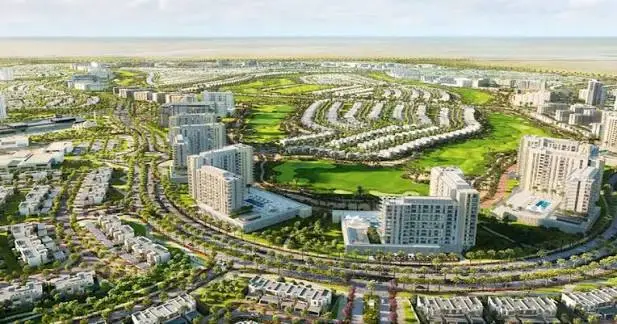
Expo City splits broadly into two zones. Expo Central holds the apartment and townhouse stock: Expo Village (2,273 studio-to-three-bedroom apartments across four clusters, the first residential units on site), plus newer towers Mangrove Residences, Sky Residences, Terra Heights and Terra Woods, and mid-rise Sidr Residences (1- to 4-bedroom units). Expo Valley, the community’s low-density neighbourhood set against a nature reserve, lake and wadi, carries villas, duets and townhouses — Yasmina Villas (4- and 5-bedroom villas), Shamsa Townhouses (3- and 4-bedroom) and Maha Villas among the named projects. Unit sizes on current listings range from roughly 418 sq ft studios in Expo Village to over 4,600 sq ft five-bedroom villas in Expo Valley.
Expo City Dubai sits within the freehold framework that covers Dubai South, registered with the Dubai Land Department under Regulation No. 3 of 2006 and the designations added since, open to buyers of any nationality. Off-plan units are registered on DLD’s Oqood system ahead of a title deed being issued at handover. As with any Dubai freehold purchase, confirm a specific unit’s registration status via DLD or the Dubai REST app before signing.
The property-investor Golden Visa requires a Dubai Land Department valuation of at least AED 2,000,000. On Bayut’s current asking-price figures (below), a number of 2- and 3-bedroom apartments and most villas in Expo City clear that threshold individually, and your Fidu agent will confirm the DLD valuation of a specific unit so you know exactly where it sits against the threshold.
Expo Village has been occupied since shortly after Expo 2020 closed in 2022 and reads as a mature, lived-in neighbourhood. Beyond that, Expo City continues to build out: current listings on Bayut show Sky Residences and Yasmina Villas both targeting handover around Q1–Q3 2026, Sidr Residences around Q1 2028, and Terra Heights and the Roudah cluster in Expo Valley Views extending to Q1 2029 and Q4 2029 respectively. The only formally published developer payment plan, for Mangrove Residences, targeted completion in Q1 2026 on a schedule of 10% on booking, 35% during construction, 5% on handover and the remaining 50% spread over five years post-handover, per Expo City Dubai Authority. Expo Central and Expo Valley continue to build out over the next several years, adding homes, amenities and residents to the district.
Bayut’s citywide Dubai Sales Market Report for H1 2026 (published 29 Jul 2026), which is DLD-transaction-based, covers the wider Dubai South submarket that Expo City sits within: average price per square foot there rose 3.27% and search-based apartment ROI came in at 7.24%. That is broader Dubai South context alongside the Expo City-specific figures below. Bayut’s own Expo City Dubai area guide, built from live listings over the trailing 12 months, instead puts average apartment asking prices at AED 1,631,000 (1-bed), AED 2,306,000 (2-bed) and AED 4,036,000 (3-bed) — with villas averaging AED 2,490,000 (2-bed), AED 4,466,000 (3-bed), AED 7,087,000 (4-bed) and AED 8,364,000 (5-bed). The same page lists a handful of actual DLD-recorded sales rather than asking prices: a 2-bed at Mangrove Residences (1,378 sq ft) for AED 2,347,635 on 11 Aug 2026, a 1-bed at Terra Woods Building 1 (753 sq ft) for AED 1,633,888 on 7 Aug 2026, and a 2-bed at Terra Woods Building 2 (1,121 sq ft) for AED 2,505,888 on 5 Aug 2026 — DLD-sourced after Bayut’s own outlier cleanup, so figures may differ slightly from DLD’s raw data. Your Fidu agent can work out the per-square-foot figure for any specific unit from its DLD-recorded price and floor area — the sharpest way to price a community this young.
Bayut’s Expo City area guide puts average apartment asking rents at AED 55,000 (studio), AED 80,000 (1-bed), AED 99,000 (2-bed) and AED 144,000 (3-bed), based on live listings over the trailing 12 months, with villa and townhouse rents quoted per property. Demand is driven by tenants who want Metro access to central Dubai without central Dubai rents, plus a genuine draw from the district’s parks and pedestrian-first layout. Bayut’s citywide Dubai Rental Market Report for H1 2026 (published 28 Jul 2026) flags neighbouring Dubai South as one of the fastest-growing affordable-villa rental submarkets, with 3-bedroom villa rents up as much as 5.27% and 5-bedroom villas up 1.79% — Dubai South context that sits alongside the Expo City figures above.
Taking Bayut’s own asking-rent and asking-sale figures above, the implied gross yield is roughly 4.9% on 1-bed apartments, 4.3% on 2-bed and 3.6% on 3-bed. That is Fidu’s own arithmetic from two separately sourced Bayut tables — a useful sense-check, and your Fidu agent will model the achievable yield on a specific unit using current comparables.
Service charges vary by building and are published per property on Mollak, RERA’s official service-charge platform — your Fidu agent will confirm the exact current figure for any Expo City unit you are considering.
Expo City Dubai Station sits on the Dubai Metro Red Line, reached via the Route 2020 extension — a 15km addition to the network (11.8km elevated, 3.2km underground) that opened in stages through 2021 and put the district on the Metro before most of its housing existed. Road access runs via Sheikh Mohammed Bin Zayed Road (E311), Sheikh Zayed Road (E11), Emirates Road (E611) and Expo Road (E77), with Al Maktoum International Airport roughly a 20-minute drive away. Internal movement around the site is designed to be pedestrian- and cycle-first, with shuttle buggies supplementing walking paths. Covered and surface parking is standard across the Expo Village and newer residential clusters.
Families in Expo City are served by GEMS Founders School – Dubai South, on Expo Road between the Expo site and Al Maktoum International Airport, which opened in August 2024 teaching the UK curriculum from FS1 to Year 9, with later year groups planned as the school grows. Its first KHDA inspection is scheduled for the 2026–27 academic year; in the meantime it took a voluntary British Schools Overseas inspection in May 2025 and was rated Good. The established campuses of the wider Dubai South and Dubailand areas add further KHDA-rated choice within a short drive.
Expo City’s own retail directory lists working, named outlets rather than a masterplan promise: Spinneys and Big Mart for groceries, BinSina Pharmacy, 5àsec for dry cleaning, and a Terra gift shop selling sustainable products. Healthcare is represented by Access Clinic DIP nearby and pharmacy coverage inside the district, including a 24-hour pharmacy at the Metro station. This is a working amenity base that continues to expand as more residential clusters hand over.
Expo City’s dining directory currently lists around a dozen named venues spread across its districts: Al Baik in the Opportunity district, Brasserie by McGettigan’s in Sky Quarter, Choy Restaurant & Lounge in the Sustainability District, Rove Lounge on Al Wasl and Horizon Avenue, plus cafés at Al Wasl Plaza, Terra and the Leadership Pavilion. The cuisine mix spans fast food, grilled, vegetarian, international and café formats. It is a dining scene spread through the district’s public realm rather than concentrated in a single mall, with wider Dubai South and the rest of the city within easy reach for a full grocery or retail run.
Al Wasl Plaza is the district’s centrepiece — a trellis-domed structure housing the world’s largest 360-degree projection dome, with gardens, pools, a café and free public entry, still used for events and nightly light shows. Terra, the Sustainability Pavilion, is a net-zero landmark with paid interactive exhibits on climate action and renewable energy. Jubilee Park, built to mark the UAE’s 50th anniversary, and the Surreal water feature add further public space, and the Garden in the Sky observation tower lifts visitors 55 metres for panoramic views. The Alif Mobility Pavilion rounds out the district’s cultural offer.
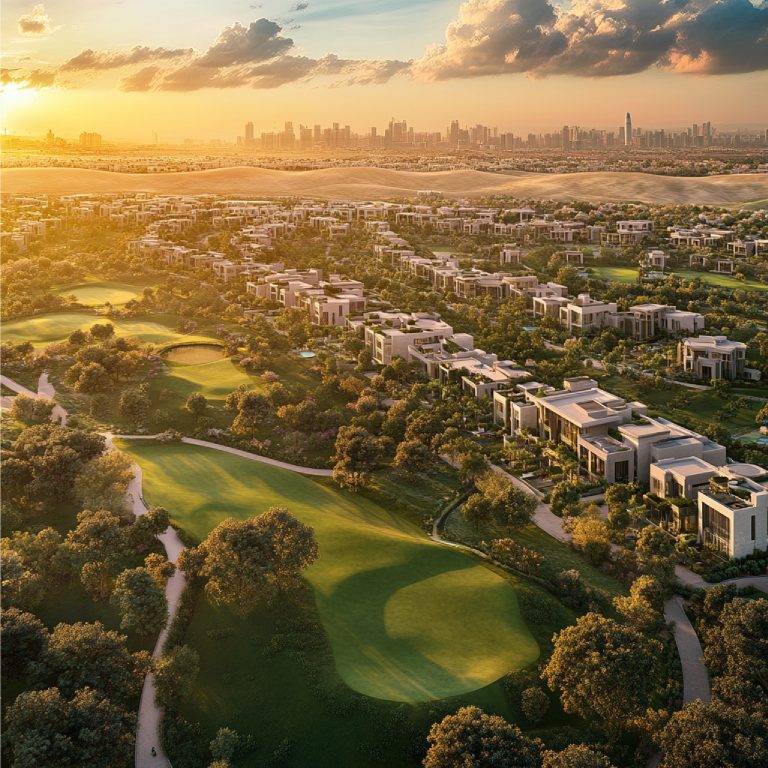
Expo City was designed around its public realm from the outset rather than having it retrofitted — wide plazas, shaded pedestrian and cycle paths, Jubilee Park’s lawns and water features, and Al Forsan Park all sit within walking distance of the residential clusters. Expo Valley adds a nature reserve, lake and wadi as its own landscaped backdrop for the villa and townhouse phases.
Expo City is a young market, and that is where the opportunity sits: pricing here is set unit by unit against live comparables and a growing set of named, DLD-recorded sales rather than against a decades-deep average. The school serving the community, GEMS Founders School – Dubai South, sits on Expo Road and takes its first KHDA inspection in 2026–27. Retail and dining are real and growing, with wider Dubai South and central Dubai an easy drive for a full weekly shop. And large parts of Expo Central and all of Expo Valley are still being delivered, with handovers running to 2029 — which means buyers in already-delivered Expo Village are watching the district fill in around them.
The closest comparison is Dubai South, the much larger freehold masterplan that physically surrounds Expo City and shares its proximity to Al Maktoum International Airport — Dubai South offers a wider range of budget-to-mid-market housing and more established retail, while Expo City trades some of that scale for a built-in Metro station, denser cultural amenities and a genuinely distinctive setting inside a former World Expo site. Against an established, high-end masterplan like Dubai Hills Estate, the gap is one of maturity and price: Dubai Hills has a deep resale history, a full-size mall and golf course, and materially higher price points, while Expo City is still building out its residential base and sits at a lower entry price with a very different, cultural-district identity. Choose Dubai South for scale, budget housing and airport proximity without the Expo-specific premium; choose Dubai Hills Estate for an established, higher-end community with a long transaction record; choose Expo City for Metro access, genuine public realm and cultural landmarks on your doorstep, in a market still early in its resale cycle.
Expo City Dubai Station on the Metro Red Line’s Route 2020 extension is the district’s defining transport asset, giving a direct rail link toward Jebel Ali, Dubai Marina and onward into central Dubai without a car. By road, Sheikh Mohammed Bin Zayed Road (E311), Sheikh Zayed Road (E11), Emirates Road (E611) and Expo Road (E77) all serve the community. Al Maktoum International Airport is about 20 minutes away by car, Dubai Investments Park roughly 9 minutes, and Dubai Parks and Resorts around 15–20 minutes. Dubai International Airport and the Marina/Downtown core sit further along the network, with the Metro Red Line running that route directly from Expo City Dubai Station.
Expo City is a young market with a structural case that is unusually strong for a community this age. Bayut’s asking-price tables show apartments from roughly AED 1.6 million (1-bed) to AED 4.0 million (3-bed) and villas from AED 2.5 million (2-bed) to AED 8.4 million (5-bed), with Fidu’s own division of Bayut’s rent and sale tables implying gross yields in the high-3% to high-4% range for apartments. The wider Dubai South submarket, which Bayut tracks in its citywide H1 2026 reports, showed 3.27% price-per-square-foot growth and search-based apartment ROI of 7.24%, pointing to solid underlying demand across the broader area. The case for Expo City rests on structural factors: a Metro station already in place, a master developer (Expo City Dubai Authority / Dubai World Trade Centre) with a permanent mandate rather than a one-off launch, and a public realm that is unusually complete for a community this young. Your Fidu agent will get current, DLD-verified pricing for a specific unit so you are acting on confirmed numbers.
The price, rent and transaction figures above come from Bayut’s own Expo City Dubai area guide — asking-price and asking-rent tables built from live listings over the trailing 12 months, plus a set of individually named, DLD-sourced recent sale transactions — with Bayut’s citywide H1 2026 reports used for wider Dubai South context. Where Fidu has derived an illustrative yield from two separately sourced Bayut tables, this is labelled as Fidu’s own arithmetic rather than a Bayut-published figure. Service charges are set per building and published per property on Mollak, RERA’s official platform, which is where Fidu confirms the current rate for a specific unit. School information reflects KHDA’s own published inspection record, with GEMS Founders School – Dubai South’s first KHDA inspection due in 2026–27.
Where a figure could not be tied to one of these named, dated sources, it is described qualitatively rather than estimated.
1 property found
AED 2,450,000
 2 Bed
2 Bed
 2 Bath
 1111 sq-ft
Terra Gardens Building 2, Terra Gardens, Expo City, Dubai

Listing by
Abdullah Ghazi