Areas
Dubai Land: Buying Guide, Prices & Listings
An orientation guide to the wider Dubailand district and its many freehold sub-communities, with links through to Fidu's dedicated guides for each one.
Areas
An orientation guide to the wider Dubailand district and its many freehold sub-communities, with links through to Fidu's dedicated guides for each one.
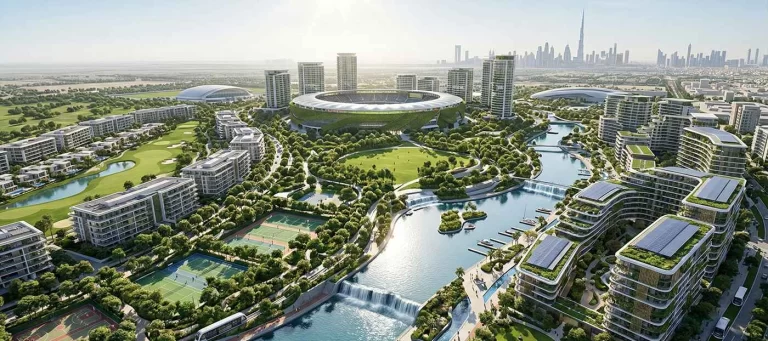
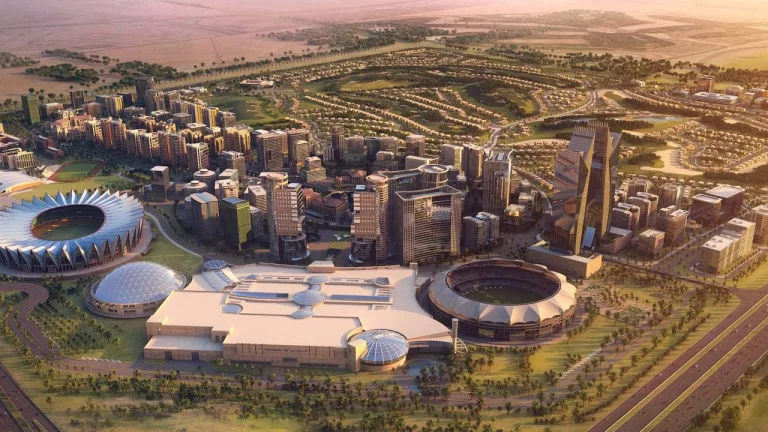
Dubai Land — almost always written as one word, Dubailand, in market reports, on portals and in the community names built inside it — was announced by Dubai Holding on 23 October 2003 as a roughly 278 sq km (107 sq mi) masterplan, more than twice the footprint of Walt Disney World. The original vision split the area into themed “worlds” — attractions, sports, eco-tourism, themed leisure, retail and a downtown core — comprising some 45 mega-projects and 200 smaller ones. Dubailand today is the umbrella name and freehold designation for a huge swathe of inland Dubai, straddling both sides of Al Ain Road and Emirates Road, inside which dozens of independently built, independently branded communities now sit.
That matters for how Fidu — and how Dubai’s property portals generally — use the “Dubai Land” tag. A number of the best-known communities inside the wider Dubailand footprint have grown large and distinct enough to be marketed, searched and reported on as destinations in their own right: Motor City, Dubai Sports City, Town Square, DAMAC Hills, DAMAC Hills 2, DAMAC Lagoons, Dubai Production City, Dubai Studio City, Dubai Land Residence Complex, International City and Jumeirah Golf Estates all have their own separate area designations and their own dedicated Fidu guides, linked throughout this page. The broader “Dubai Land” area tag covers everything alongside those — smaller or newer sub-communities that do not yet carry their own separate listing category, plus land and projects marketed under the Dubailand name itself. Bayut’s own area guide describes the wider district as “a large-scale master development that brings together residential communities, leisure facilities and retail and entertainment destinations,” citing more than 50 visitor attractions across the footprint as a whole.
A “Dubai Land” listing is a starting point. It tells you a property sits within this large inland district — broadly mid-market, broadly freehold, well served by the E311, E611 and D63 — and the district’s breadth is its strength, spanning everything from established low-rise apartment clusters to brand-new off-plan villa compounds. Buyers who already know they want Motor City’s motorsport theming, Town Square’s park-centred townhouses, or DAMAC Hills’ golf-course villas should go straight to that community’s own Fidu guide, linked below. This page is for buyers who are starting broader — comparing Dubailand as a whole against other parts of Dubai, or trying to understand how its many named pockets relate to one another — before narrowing down.
Dubailand’s property mix is unusually wide because it was never built by one developer to one brief. Fidu already publishes dedicated guides for its most established named sub-communities, and this page links out to each rather than repeating their detail:
Beyond these, Bayut’s own Dubailand area guide lists further established neighbourhoods that sit inside the wider district without (yet) a dedicated Fidu guide of their own — including Villanova, Rukan, Al Waha, Living Legends, The Villa, Mudon, Remraam and Skycourts. Fidu will publish standalone guides for these as inventory and buyer demand justify it; in the meantime, listings tagged simply “Dubai Land” may point to any of them, or to newer off-plan launches such as the R. Hills villa project that Bayut’s H1 2026 sales report flags as one of the district’s current affordable-villa draws.
Dubailand, across its full footprint, is registered with the Dubai Land Department as freehold and open to all nationalities, under the framework set out in Regulation No. 3 of 2006 and the designations added since. This applies uniformly whether a specific plot sits inside one of the named sub-communities above or in a less-established pocket still marketed under the general Dubailand name — but as with any Dubai freehold purchase, confirm a specific unit’s registration status via DLD or the Dubai REST app before signing.
The property-investor Golden Visa requires a Dubai Land Department valuation of at least AED 2,000,000. Because Dubailand spans everything from budget studios to multi-million-dirham villas, eligibility depends on which specific property and sub-community you choose — a compact apartment sits below the threshold on its own, while Bayut’s H1 2026 sales data (see below) puts the average transacted price for an affordable villa tagged simply “Dubai Land” at just under AED 2.93 million, comfortably above it. Your Fidu agent will confirm the DLD valuation of any specific unit so you know exactly where it stands.
Completion status varies enormously by sub-community and cannot be generalised across the whole district. Some pockets — International City, the original phases of Motor City and Dubai Sports City — are built out and occupied, with stock dating from the 2010s or earlier. Others, including DAMAC Hills 2, DAMAC Lagoons and Dubai Land Residence Complex, are still under active construction with phased handovers ongoing, and new off-plan launches (R. Hills among them) continue to appear on land tagged generally as Dubai Land. Fidu’s guide for each sub-community, and the project’s own DLD escrow record, set out exactly where a specific development stands.
Pricing across a district this varied is best read sub-community by sub-community, and the dedicated Fidu guides linked above carry the sourced sale and rent tables for each. At district level, the figure worth knowing comes from Bayut’s citywide H1 2026 sales report, below.
The district-level figure comes from Bayut’s Dubai Sales Market Report H1 2026 (published 29 Jul 2026, built from DLD transaction data), which tracks “Dubai Land” as a named entity specifically within its affordable villas segment, alongside DAMAC Hills 2 and Dubai South. Over that report period, Dubai Land’s affordable-villa transactions averaged AED 1,609 per sq ft and an average transaction value of AED 2,925,169, with typical prices of roughly AED 3,113,000 for a 3-bedroom, AED 4,029,000 for a 4-bedroom and AED 11,403,000 for a 5-bedroom villa. That figure covers villas specifically, drawn from transactions across the villa projects marketed under the Dubailand name during the report period. It is good directional evidence that Dubailand’s villa segment sits in the city’s affordable bracket, and your Fidu agent will price an individual unit against its own recent comparables.
Rental figures for this district are published sub-community by sub-community: each of the individual Fidu guides linked above carries its own sourced rent table, which is the level at which rents here are genuinely comparable. In general terms, demand across the wider district is driven by tenants who get materially more space per dirham here than they would closer to the coast or Downtown — the same dynamic that shows up, sub-community by sub-community, in Fidu’s Motor City, Dubai Sports City and Town Square guides.
The same Bayut H1 2026 sales report gives an ROI of 5.23% for Dubai Land’s affordable-villa segment, against 6.03% for neighbouring DAMAC Hills 2 and 4.92% for Dubai South in the same table. That places “Dubai Land” villas alongside its closest affordable-villa comparators in the same table. Apartment yields are published sub-community by sub-community — see the guides above, several of which (Dubai Sports City, International City) carry their own sourced yield tables.
Service charges vary by building, developer and sub-community across a district this large, and are published per property on Mollak, RERA’s official service-charge platform. Your Fidu agent will confirm the exact figure for any unit you are considering, and the specific sub-community’s own Fidu guide carries more detail where one exists.
The district’s arteries are Sheikh Mohammed Bin Zayed Road (E311), Emirates Road (E611) and Al Qudra Road (D63), which together connect its various pockets to each other and to the rest of Dubai. Road access is the district’s strength, and it is what makes Dubailand’s space-for-money possible. Bayut’s own area guide cites Creek Metro Station on the Green Line as roughly 19 minutes away by car from the area it profiles, a useful order-of-magnitude figure given how far apart different corners of the district are. Dubailand is a driving district, and each sub-community’s own Fidu guide sets out its specific transport picture.
Schools here are a sub-community-level fact, and Fidu covers them in the guide for the community they actually serve: Fidu’s Motor City guide, for example, covers GEMS Metropole School — Dubai Branch, KHDA-rated Good for 2023–2024, and other sub-community guides in this district cover their own local schools. The specific sub-community’s guide, or KHDA’s own school directory at khda.gov.ae — the only source Fidu treats as authoritative for inspection ratings — gives the catchment relevant to a specific address.
As with schools, day-to-day amenities are a sub-community-level fact rather than a district-wide one. Established pockets such as Motor City (First Avenue Mall, Spinneys, Géant) and International City (Dragon Mart) have their own retail and grocery anchors, covered in their respective Fidu guides; newer corners of Dubailand draw on their neighbours’ retail, pharmacies and healthcare while their own is delivered. Your Fidu agent will confirm what is open and operating near a specific property so you know exactly what you have on the doorstep.
Retail is concentrated in the district’s more built-out sub-communities rather than spread evenly across it — First Avenue Mall in Motor City and Dragon Mart in International City are the two largest examples, both covered in their own Fidu guides. At a district level, Dubai Outlet Mall sits on Emirates Road at the district’s edge and functions as a broader draw for outlet and discount shopping, drawing residents from across Dubailand’s various pockets rather than any single community.
The wider Dubailand footprint carries some of Dubai’s best-known standalone attractions, distinct from any single residential sub-community. IMG Worlds of Adventure, one of the world’s largest indoor theme parks, sits in the City of Arabia zone on Sheikh Mohammed Bin Zayed Road (E311). Dubai Miracle Garden and the attached Dubai Butterfly Garden occupy a site in Al Barsha South 3, also within the Dubailand designation, and Bayut’s area guide points to more than 50 visitor attractions across the district as a whole, reflecting its founding mandate as an entertainment and leisure masterplan.
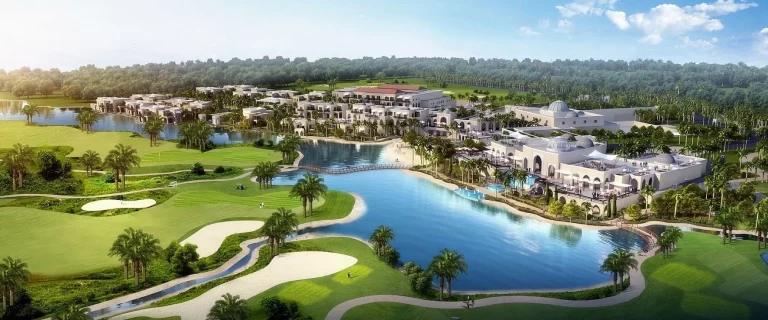
Outdoor amenity again varies by pocket: Jumeirah Golf Estates and DAMAC Hills each carry championship golf courses (home to DP World Tour events at Jumeirah Golf Estates, and the Trump International Golf Club Dubai at DAMAC Hills), Town Square is built around a large central park, and Motor City’s Green Community carries landscaped villa gardens. Each sub-community’s outdoor space is its own, and the linked guides above set out what each one offers.
The “Dubai Land” tag is a starting filter rather than a destination in itself: it tells you a property sits within this large inland district, and the sub-community name tells you the rest — so confirm the exact sub-community and read its own Fidu guide alongside any Dubai Land listing. The district is built for driving, with the E311, E611 and D63 on its doorstep. Construction is active in several pockets at once (DAMAC Hills 2, DAMAC Lagoons, Dubai Land Residence Complex and new off-plan launches such as R. Hills among them), which keeps new homes, retail and amenities arriving across the district. And because pricing and yield genuinely vary this much by pocket, sub-community-specific research is where the value is found — your Fidu agent can run that comparison with you.
Dubai South is Dubailand’s closest peer as a large, still-developing freehold district on the city’s fringe — both trade proximity to the coast for space and lower entry prices, and both mix mature and still-under-construction pockets within one broad area tag. The difference is theme and infrastructure: Dubai South is built around Al Maktoum International Airport and the Expo 2020 site with an aviation-and-logistics identity, while Dubailand’s identity is entertainment and sport — the Autodrome, IMG Worlds of Adventure, two championship golf courses. Against Jumeirah Village Circle, the comparison is really apartment-density-versus-villa-space: JVC packs its stock into a compact, mid-rise apartment grid close to Al Khail Road, while Dubailand’s affordable-villa segment (per Bayut’s H1 2026 data) offers considerably more space per dirham, with drive times set by which corner of the district you’re in. Choose Dubai South for airport-adjacent logistics access and newer master-planned infrastructure; choose JVC for compact, centrally located apartment stock; choose a specific Dubailand sub-community — via the links above — for villa space and price, with the commute set by the pocket you pick.
Drive times from Dubailand vary meaningfully depending on which sub-community you’re actually in, since the district spans a large area on both sides of Al Ain Road. As a general order of magnitude, Fidu’s Motor City guide puts Downtown Dubai and Dubai Marina at roughly 18–24 minutes away in typical traffic, and DXB at around 39 minutes — pockets further south or east of the district, such as DAMAC Hills 2 or Dubai Land Residence Complex, will generally run longer on all of these. Al Maktoum International Airport tends to run shorter than DXB from Dubailand’s southern pockets and longer from its northern ones. Sheikh Mohammed Bin Zayed Road (E311), Emirates Road (E611) and Al Qudra Road (D63) are the roads that matter, and the drive times in each sub-community’s own Fidu guide are the ones to work from once you have narrowed down.
On the district-wide figure — Bayut’s H1 2026 sales report putting Dubai Land’s affordable-villa ROI at 5.23%, against an average transaction value of roughly AED 2.93 million — the answer is a solid yield in the affordable villa bracket. That figure covers one segment: Dubailand’s apartment stock, its higher-end pockets (Jumeirah Golf Estates) and its many developing sub-communities each carry their own return profile, covered where possible in their own Fidu guides. The genuine investment case for Dubailand as a whole is structural rather than statistical — freehold status across the district, continued developer activity and off-plan launches (R. Hills among the most recent), and consistently lower entry prices than Dubai’s coastal and central addresses. Use the umbrella “Dubai Land” tag as a starting filter, then read the community’s own Fidu guide — and your Fidu agent will get DLD-verified pricing for the specific sub-community and unit you shortlist.
District-level pricing in this guide comes from Bayut’s citywide, DLD-transaction-based market reports rather than from portal area-guide tables. The one genuine district-level pricing and yield figure in this guide — the affordable-villas line for “Dubai Land” — comes instead from Bayut’s citywide Dubai Sales Market Report H1 2026, which is DLD-transaction-based and does track Dubai Land as a named entity within that specific segment. Apartment and rental figures are published at sub-community level, so this page describes them qualitatively and points to the individual Fidu guide for each community, where the sourced tables sit. Sub-community-specific pricing, rents, yields, schools and service charges are intentionally not duplicated here — see the linked Fidu guide for each named sub-community.
Where a figure could not be tied to one of these named, dated sources, it is described qualitatively rather than estimated.
1 property found
AED 3,100,000
 3 Bed
3 Bed
 4 Bath
 1808 sq-ft
Haven By Aldar, Dubai Land, Dubai, Glade

Listing by
Nirmal Sebastian
1 property found
AED 220,000 /year
3 Bed
5 Bath
3031 sq-ft
California Residence, California Village, Dubai

Listing by
Salik Aziz