Areas
Dubai Studio City: Buying Guide, Prices & Listings
A TECOM broadcasting and media production free zone in Dubailand, with a small and newly emerging pocket of freehold apartments.
Areas
A TECOM broadcasting and media production free zone in Dubailand, with a small and newly emerging pocket of freehold apartments.
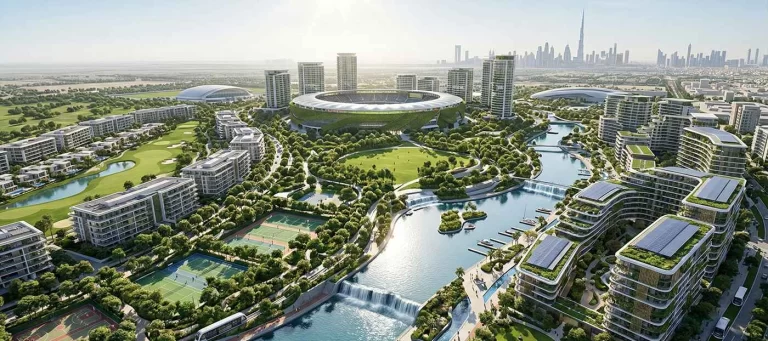
Dubai Studio City is a TECOM Group free zone in Dubailand, built for the broadcasting and film-production industry rather than for housing. It opened in 2005 as a three-phase development covering roughly 22 million square feet, and it sits alongside Dubai Media City and Dubai Production City in what TECOM calls its Media Cluster. The zone’s built environment is dominated by sound stages, backlots, sets, water tanks, production offices, boutique studios, light-industrial units and commercial office space, plus a dedicated hotel, Studio One Hotel, for crews and business visitors.
A residential layer has started to appear on top of that — a small number of freehold apartment towers, including Ghaff Land Residence and Azizi Developments’ Beach Oasis 2, both still under construction. Fidu currently has live listings in Azizi Beach Oasis 2. Dubai Studio City is, first and foremost, a working production district — most of the land here is leased to production and commercial tenants, which gives the new apartment towers a built-in, on-the-doorstep tenant base. Buyers who also want a longer-established residential setting nearby can compare Motor City and the wider mixed-use Dubai Production City.
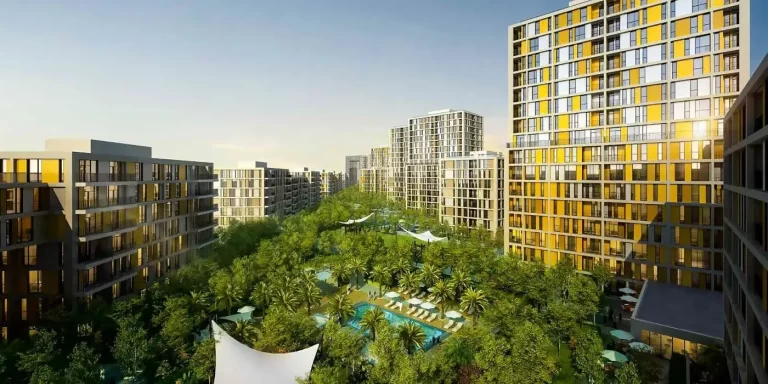
Fidu’s current inventory in Dubai Studio City is off-plan apartments in Azizi Beach Oasis 2, a 10-storey Azizi Developments tower with studio, 1- and 2-bedroom units and a shared lagoon-style pool, expected to hand over around mid-2026. The other notable residential project is Ghaff Land Residence, a 168-unit building from Arabian Gulf Properties / Refine Development Management offering studios, 1- and 2-bedroom apartments and 2-bedroom duplexes, targeting completion in late 2027. Both are recent additions to a district whose land bank is largely allocated to studios and commercial units, which keeps residential supply here genuinely scarce. For more established residential blocks and villas nearby, also see Motor City directly north.
Dubai’s foreign-ownership framework starts with Regulation No. 3 of 2006 (Dubai Land & Property Department), which named the emirate’s first designated freehold areas — Dubai Marina, Palm Jumeirah, Emirates Hills and similar communities. Freehold status here rests on the later government decisions that extended designated ownership areas to TECOM free zones and Dubailand, which is why developers such as Azizi and Arabian Gulf Properties market units to non-UAE nationals on a freehold basis. Your Fidu agent will confirm the ownership structure on the title deed for any unit you are considering, so the position is documented before you sign.
The federal threshold is unchanged regardless of area: a property (or portfolio of properties) valued at AED 2,000,000 or more at the Dubai Land Department can qualify a buyer for the UAE’s 10-year Golden Visa, subject to the standard eligibility rules. Given the accessible unit prices at Azizi Beach Oasis 2 and Ghaff Land Residence, buyers here typically reach the threshold by combining units or by pairing this purchase with another Dubai property — your Fidu agent can structure a qualifying portfolio around it.
Both live residential projects here are off-plan and under construction. Azizi Beach Oasis 2 is being marketed toward a Q2 2026 handover, and Ghaff Land Residence toward completion in December 2027; both dates come from developer and market listings, and your Fidu agent will reconfirm the current handover schedule directly with the developer. Buying here today means buying off-plan, at launch pricing and on a developer payment plan.
Despite this area’s business/media-zone character, Bayut’s Dubai Studio City area guide shows genuine residential apartment stock with real pricing: average asking sale prices of AED 653,000 (studio), AED 981,000 (1-bed), AED 1,545,000 (2-bed) and AED 1,610,000 (3-bed), based on listings over the trailing 12 months. Your Fidu agent can work out the per-square-foot figure for any specific unit from its price and floor area.
The same Bayut area guide puts average asking rents at AED 49,000 (studio), AED 71,000 (1-bed), AED 104,000 (2-bed) and AED 121,000 (3-bed), based on listings over the trailing 12 months.
Bayut’s own ROI calculation for Dubai Studio City, based on user searches over the trailing 12 months, puts apartment yields at 6.40%–8.17% depending on size — a genuinely strong, affordable-apartment-style return. This is a listings-and-search-based estimate; your Fidu agent can model the achievable yield on a specific unit using current comparables.
Service charges vary by building and are published per property on Mollak, RERA’s official service-charge platform, accessible via the Dubai REST app — your Fidu agent will confirm the exact current figure for any unit you are considering.
Dubai Studio City sits off Al Qudra Road, with onward access to Hessa Street and Sheikh Mohammed Bin Zayed Road (E311), giving quick road access across the city. Dubai Metro is reached by bus connection, either north to the Red Line at Mall of the Emirates or west to the Route 2020 extension at Al Furjan. New apartment buildings such as Azizi Beach Oasis 2 and Ghaff Land Residence come with basement or podium parking allocated per unit, standard for this type of mid-rise development.
Families here are served by GEMS Metropole School – Motor City (UK curriculum, Foundation Stage to Year 13), about a two-minute drive north in Motor City. Its KHDA inspection record, read directly from web.khda.gov.ae, shows 2023–2024 Good and 2022–2023 Good — a school that has improved to a consistent Good rating across its two most recent inspections. Early-years options are concentrated in neighbouring Motor City and Dubai Production City, both minutes away.
On-site amenities reflect the zone’s working character: cafes, restaurants and fitness facilities serving the production and office workforce, plus Studio One Hotel for business travellers. Day-to-day retail and healthcare sit a short drive away: Motor City’s First Avenue Mall (over 50 retail stores, around 15 F&B outlets) is the nearest significant shopping centre, and a Mediclinic clinic operates at City Centre Me’aisem in neighbouring Dubai Production City. New residential buildings add their own pools and gyms on site.
Food and retail directly inside Dubai Studio City serve the media and business workforce — cafes and casual dining within walking distance of the studios and offices. For a bigger shopping trip or a wider choice of restaurants, First Avenue Mall in Motor City is minutes away, with Mall of the Emirates further along the same route. What you get in exchange is proximity to a working production hub and the daytime population that comes with it.
The best-known nearby landmark is the Dubai Autodrome in Motor City, roughly a five-minute drive away, an FIA-sanctioned circuit used for motorsport events and karting. Dubai Miracle Garden and Dubai Butterfly Garden, both in neighbouring Al Barsha South, are also within easy reach. Within the zone itself, the landmarks are working ones — sound stages, backlots and production facilities used for film, TV and advertising shoots, which is the point of the district.
Outdoor amenity here is building-level and private to residents — pool decks and landscaped courtyards within projects such as Azizi Beach Oasis 2 and Ghaff Land Residence. For wider green, walkable space, Motor City’s established landscaping is a short drive north.
This is a business-first district that has begun accepting residential towers, and that shapes what buying here offers: a scarce residential supply inside a large working production zone, entry prices below more established freehold areas, and a built-in daytime population of production and office tenants on the doorstep. Retail, dining, schools and nurseries are concentrated minutes away in Motor City and Dubai Production City, and the Metro is reached by bus connection at Mall of the Emirates or Al Furjan. Both live projects are off-plan, so buyers get launch pricing and a developer payment plan, with handover dates your Fidu agent will reconfirm with the developer before you commit.
Dubai Production City (formerly International Media Production Zone) is a separate, adjacent TECOM free zone with a broader, more established mix of residential apartment buildings, retail and everyday services alongside its media-production tenants — it reads as more of a lived-in mixed community. Motor City, immediately north, is the most residential of the three: villas, townhouses and apartments built around the Dubai Autodrome and First Avenue Mall, with a longer-established population. Dubai Studio City sits between the two in character — primarily a working production and business-park district with a new apartment layer on top, and the earliest entry point of the three. Weigh that stage of development, alongside price per square foot, when comparing them.
By car, Al Qudra Road and Sheikh Mohammed Bin Zayed Road (E311) connect Dubai Studio City to Dubai Marina and JBR in roughly 20–25 minutes and to Downtown Dubai and Business Bay in around 25–30 minutes outside peak traffic. For public transport, a feeder bus connects the zone to the Red Line, either at Mall of the Emirates or Al Furjan (Route 2020).
Bayut’s own ROI estimate for Dubai Studio City apartments is genuinely strong — 6.40%–8.17% depending on size, a listings-and-search-based estimate rather than a DLD-confirmed transaction yield, but a real, positive data point. Entry prices (studios from around AED 653,000) sit below many established freehold communities closer to the metro or coast, which can appeal to investors prioritising a lower ticket size. The zone’s core identity remains business and production, which keeps residential supply here scarce against a large working population — scarcity that works in an owner’s favour on letting. Compare it against Fidu’s other off-plan listings to see where it fits in your portfolio.
Sales, rental and ROI figures are drawn from Bayut’s Dubai Studio City area guide, based on live listings and user searches over the trailing 12 months. Service charges here are set per building and published per property on Mollak, RERA’s official platform, which is where Fidu confirms the current rate for a specific unit.
Where a figure could not be tied to one of these named, dated sources, it is described qualitatively rather than estimated.
3 properties found
AED 1,450,000
 2 Bed
2 Bed
 2 Bath
 1677 sq-ft
Ghaff Land Residence, Dubai Studio City, Dubai

Listing by
Salik Aziz
AED 1,652,000
2 Bed
3 Bath
1038 sq-ft
Azizi Beach Oasis 2 Tower B, Azizi Beach Oasis 2, Dubai Studio City, Dubai

Listing by
Nazish Khan
AED 1,068,000
1 Bed
2 Bath
660 sq-ft
Azizi Beach Oasis 2 Tower B, Azizi Beach Oasis 2, Dubai Studio City, Dubai
Listing by
Nazish Khan