Areas
Dubai Harbour: Buying Guide, Prices & Listings
A Meraas-developed waterfront district between Dubai Marina and Palm Jumeirah, anchored by a 1,100-berth marina and Emaar Beachfront's island towers.
Areas
A Meraas-developed waterfront district between Dubai Marina and Palm Jumeirah, anchored by a 1,100-berth marina and Emaar Beachfront's island towers.
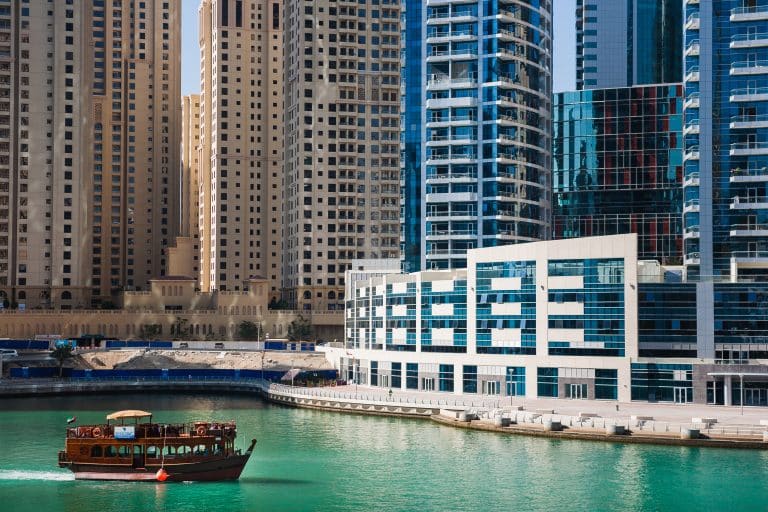
Dubai Harbour is a Meraas-developed waterfront district spanning more than 20 million sq ft, sitting on the coastline between Dubai Marina and Palm Jumeirah. The masterplan is built around maritime tourism infrastructure — a 1,100-berth marina, two cruise terminals, and the landmark Dubai Lighthouse — alongside a residential layer led by Emaar Beachfront, a separately developed island community within the wider Dubai Harbour masterplan. Emaar Beachfront alone comprises 10,000 residential units across 27 towers, including Sunrise Bay, Grand Bleu Tower, Marina Vista, South Beach and Beach Isle, with roughly 13,000 sq m of retail space at ground level.
Dubai Harbour suits buyers who want a genuine beachfront address between two of Dubai’s most established waterfront communities, with direct marina and promenade access and a working maritime-tourism identity — cruise terminals, superyacht berths — that neither Dubai Marina nor Palm Jumeirah quite replicates. It is a newer district still adding towers and amenity, with average asking prices well into the millions and the retail, schooling and everyday services of Dubai Marina and JBR a short drive away while its own layer matures.
Housing stock is almost entirely apartments and penthouses within Emaar Beachfront’s towers, running from 1 to 4-bedroom apartments up to 4-bed penthouses; Emaar’s own marketing also references 3- to 5-bed villas within the wider Emaar Beachfront community. Sunrise Bay, Grand Bleu Tower, Marina Vista, South Beach and Beach Isle are the named towers most consistently referenced across current listings. Residential supply sits within the Emaar Beachfront towers, with the wider Dubai Harbour masterplan’s marina-facing commercial and hospitality layer built around them.
Dubai Harbour is freehold, open to all nationalities. Emaar Beachfront, the district’s main residential component, is explicitly marketed by Emaar as full freehold ownership. As a newer, Meraas-led waterfront development, its freehold status rests on a designation added to the framework since 2006, in the same category as other recent Meraas communities such as Bluewaters and City Walk. As with any Dubai freehold purchase, confirm a specific unit’s registration status via DLD or the Dubai REST app before signing.
The property-investor Golden Visa requires a Dubai Land Department valuation of at least AED 2,000,000. On the pricing below — average asking prices running into the millions across Dubai Harbour and specifically around AED 6.26M for Emaar Beachfront — most units here comfortably clear the threshold; smaller or lower-floor units should still have their DLD valuation confirmed individually rather than assumed from the area average.
Dubai Harbour is a genuinely mixed-maturity district: parts of the marina and cruise-terminal infrastructure are complete and operating, while Emaar Beachfront’s residential towers have been delivered in phases, with some towers complete and others still under construction as the masterplan continues to build out. Your Fidu agent will confirm the completion status and handover date of any individual tower you are considering.
Bayut’s own listings data, over the trailing 12 months, puts the average sale price for a Dubai Harbour property at AED 6,955,865, with residential prices on the platform ranging from AED 2,100,000 to AED 135,000,001 — a genuinely wide range reflecting everything from entry-level apartments to the district’s most exclusive units. Over the trailing six months, the average asking price for an apartment specifically was around AED 6,265,429, with Emaar Beachfront apartments averaging a similar AED 6,260,041. These are average transaction and asking-price figures rather than a per-square-foot rate; your Fidu agent will provide the current PSF for the specific tower and unit you are considering.
Bayut’s own listings data puts the average asking rent for a Dubai Harbour apartment at AED 226,144 a year, with a separate figure citing average yearly rents around AED 243,000 — with 982 new apartment rental contracts registered over the trailing 12 months. Demand is driven by tenants wanting a genuine beachfront address with marina and promenade access, drawn to Dubai Harbour’s newer towers and cruise-terminal identity as an alternative to the more established, denser Dubai Marina immediately north.
Dividing the average asking rent (AED 226,144) by the average asking sale price (AED 6,265,429) from Bayut’s own listings data above gives an indicative gross yield of roughly 3.6% — a Fidu calculation from two separately published Bayut figures, not a directly reported ROI, and should be treated as an indicative range only, particularly given how wide the underlying price range is across the district’s different towers and unit sizes.
Service charges vary by individual tower and are published per property on Mollak, RERA’s official service-charge platform — your Fidu agent will confirm the exact figure for any unit you are considering, which matters here given the mix of towers and developers across the wider masterplan.
Dubai Harbour is served by two Metro stations, Dubai Internet City and Sobha Realty, both roughly a 13-minute drive away per current published transit coverage. Bus stops serve the area within a 5-to-10-minute drive, and the Media City Tram Station is within similar reach. Covered and valet parking is standard across Emaar Beachfront’s towers.
Dubai Harbour is served by the established schools of neighbouring Dubai Marina and Jumeirah Beach Residence, all within a short drive — your Fidu agent will confirm exact distances and current KHDA ratings for any property you are considering.
Emaar Beachfront’s own retail podium, roughly 13,000 sq m, covers ground-floor dining and retail for residents; for larger everyday needs, Dubai Marina Mall and Marina Walk are both a short drive north.
Dubai Harbour’s promenade is built specifically around dining and leisure, lined with restaurants and cafés overlooking the marina and cruise terminals; Emaar Beachfront’s own retail podium adds further ground-floor dining. The strip is genuinely active and still growing, with Dubai Marina Walk’s larger dining line-up a short drive north.
The Dubai Lighthouse is the district’s defining landmark, alongside the 1,100-berth marina and Dubai Harbour Cruise Terminal, which brings regular cruise-ship traffic and associated events. The beach itself, running along Emaar Beachfront’s towers, is the other main draw, offering direct sea access distinct from Dubai Marina’s more inland, canal-facing position.
Emaar Beachfront’s own beach frontage is the district’s primary outdoor amenity, alongside the marina promenade.
Dubai Harbour is best suited to buyers who want a genuine beachfront address between Dubai Marina and Palm Jumeirah, with a 1,100-berth marina, the cruise terminals and the Dubai Lighthouse on the doorstep. It is priced at a premium — average asking prices in the millions — which is what a scarce, newly built stretch of coastline commands, and 982 new apartment rental contracts over the trailing 12 months show the letting market keeping pace. Parts of the district are still delivering, so newer towers will keep arriving alongside those already fully occupied, and Dubai Marina’s mature retail and dining base sits a short drive north while Dubai Harbour’s own layer matures. Service charges, tower handover dates and per-unit pricing are all confirmed per property by your Fidu agent.
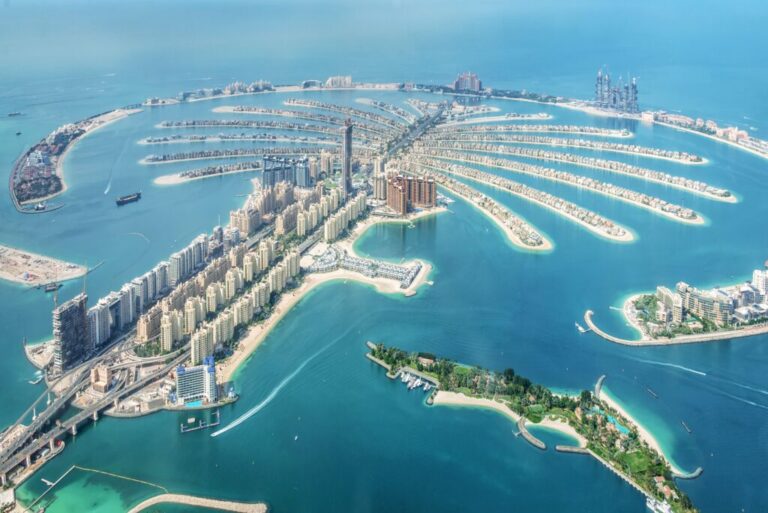
Dubai Harbour sits physically between these two established waterfront communities, and the comparison is a genuine one, not a stretch. Dubai Marina is denser, more mature, and offers a far larger, more settled retail and dining base along Marina Walk, at a generally lower price point than Dubai Harbour’s newer stock, with Marina’s canal-facing setting alongside Dubai Harbour’s direct beachfront. Palm Jumeirah is the closer price-point match, sharing a similar premium beachfront positioning, with Palm Jumeirah’s fully built-out, iconic-shape masterplan alongside Dubai Harbour’s newer, still-growing marina district. Choose Dubai Harbour for the newest stock and a working maritime-tourism identity with direct beach access; choose Dubai Marina for a larger, more mature amenity base at a lower entry price; choose Palm Jumeirah for the most established, most iconic beachfront address at a comparable premium.
Dubai Marina and Jumeirah Beach Residence are both immediately adjacent; Sheikh Zayed Road is within easy reach for onward journeys across the city. The Dubai Internet City and Sobha Realty Metro Stations, roughly 13 minutes away by car, are the nearest fixed-schedule public transport option.
The case here rests on scarcity and positioning rather than a standout yield figure: Fidu’s own indicative calculation from Bayut’s listings data puts gross yield at roughly 3.6%, the pattern typical of a premium, capital-value-led waterfront address and consistent with Fidu’s other prime-address guides. The stronger argument is Dubai Harbour’s genuinely unique positioning — direct beachfront between two established communities, with cruise-terminal and marina infrastructure neither neighbour fully replicates — an argument that rests on long-term appreciation and lifestyle demand. Your Fidu agent will provide current, DLD-verified pricing and confirm the specific tower’s handover and completion status.
Pricing and rent figures come from Bayut’s own listings data for Dubai Harbour — asking-price and transaction-average figures. The gross yield figure is Fidu’s own calculation from two separately published Bayut figures, labelled as such throughout. Service charges, tower handover dates and school distances vary by property and are confirmed per unit by your Fidu agent rather than quoted as an area average.
Figures in this guide are tied to the named, dated sources above; anything that varies building by building is confirmed per property by your Fidu agent.
No properties found in Dubai Harbour at the moment.