Areas
Deira: Buying Guide, Prices & Listings
Dubai's original trading district on the north bank of the Creek — dense, largely non-freehold, and anchored by the Gold Souk, Spice Souk and Deira Corniche.
Areas
Dubai's original trading district on the north bank of the Creek — dense, largely non-freehold, and anchored by the Gold Souk, Spice Souk and Deira Corniche.
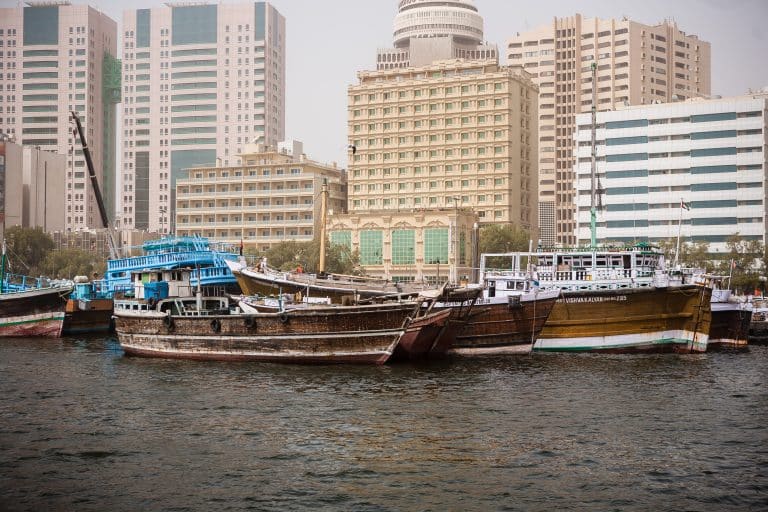
Deira is Dubai’s oldest urban district — the trading quarter that grew up on the north bank of Dubai Creek decades before Sheikh Zayed Road or any of the emirate’s newer masterplans existed. It is not a single, neatly bounded community but a large, dense patchwork of sub-areas: Al Rigga and Port Saeed near the Creek and Deira City Centre; Naif, Al Murar and Rigga Al Buteen around the souks; Hor Al Anz, Abu Hail and Al Baraha further inland; and Al Mamzar on the Corniche toward the Sharjah border. The Gold Souk, Spice Souk, Perfume Souk and Naif Souk sit at its historic core, alongside the working Dhow Wharfage where wooden cargo dhows still load and unload along the Creek. Deira’s identity is inseparable from that trading history — it was Dubai’s main commercial centre before Downtown Dubai or Business Bay existed, and it remains one of the city’s most affordable and densely populated residential areas today.
Deira suits tenants and buyers who want a low entry price, an established building stock and a genuinely central, transit-accessible location close to Dubai International Airport. Full ownership across Deira’s residential sub-areas sits with UAE and GCC nationals, while international investors buy in through leasehold or usufruct structures of typically up to 99 years — your Fidu agent will confirm the exact tenure of any specific plot with the Dubai Land Department.
Deira’s housing stock is mostly low- and mid-rise apartments, with a smaller pocket of villas and sha’abi-style housing, plus a distinct layer of mixed-use souk-front buildings that combine ground-floor retail with residential units above. The apartment stock runs from studios up to 3-bedroom units, concentrated in Al Rigga, Port Saeed, Naif and Hor Al Anz in established mid-rise blocks. Villas sit on the district’s fringes, in areas such as Abu Hail and Al Baraha. In the historic core around the Gold, Spice and Perfume Souks, buildings combine commercial units at street level with residential flats above — a genuinely distinct property type from either standalone apartments or villas, and one that shapes daily life in central Deira more than in almost any other Dubai district.
Deira is a leasehold market for international buyers, and the framework is well documented: full ownership across Deira’s sub-areas, Naif, Port Saeed, Al Rigga and Rigga Al Buteen among them, sits with UAE and GCC nationals, while foreign buyers acquire through leasehold or usufruct arrangements of typically up to 99 years — a long-horizon ownership structure. One useful distinction: Dubai Islands — the reclaimed waterfront destination formerly marketed as Deira Islands — is a designated freehold area open to foreign buyers, sitting offshore just north of Deira’s mainland streets. Buyers who want freehold ownership in this part of the city can look at Dubai Islands, Dubai Creek Harbour or Al Jaddaf, and your Fidu agent will verify a specific plot’s registration status via the Dubai Land Department or the Dubai REST app before you make an offer.
The property-investor Golden Visa requires a Dubai Land Department valuation of at least AED 2,000,000. For UAE and GCC nationals buying in Deira, larger apartments or a combined property holding are the route to that threshold. Buyers targeting the Golden Visa through a freehold purchase can also look at the designated areas nearby — Dubai Islands, Dubai Creek Harbour or Al Jaddaf — and your Fidu agent can talk you through both.
Deira’s residential core is fully built out — this is a long-established housing stock with a settled tenant base rather than a masterplan under active delivery, and your Fidu agent will confirm the condition and service history of any specific building. The area has seen targeted regeneration rather than wholesale redevelopment: the old Deira Fish Market, which had operated since 1958, was replaced in 2017 by the modern, air-conditioned Waterfront Market in Al Ras, and various municipal upgrades have modernised parts of the souk district over the years. New residential tower construction in recent years has concentrated on Dubai Islands, the separate freehold destination just offshore, leaving Deira’s own streets settled and established.
Bayut’s Dubai Sales Market Report H1 2026 references Deira as a community that continues to attract budget-conscious buyers. Bayut’s own asking-price index for Deira apartments put the average at AED 1,143 per sq ft as of July 2026; by size, 2-bed units asked AED 812 per sq ft and 3-bed units AED 1,217 per sq ft. On the villa side, Bayut’s index put the average asking price at AED 578 per sq ft, with 4-bed villas at AED 892 per sq ft. These are listings-based asking prices, and they place Deira among the most accessible entry points anywhere in central Dubai.
Bayut’s apartment rent-price index for Deira put the average asking rent at AED 89 per sq ft as of July 2026. By size: studios asked AED 115 per sq ft, 1-bed units AED 88, 2-bed units AED 85, 3-bed units AED 73, 4-bed units AED 84 and 5+ bed units AED 100. Villa rents are moving strongly: Bayut’s villa rent index averaged AED 52 per sq ft overall, up 14.6% year-on-year, with 3-bed villas up to AED 58 per sq ft (+15.05%), 4-bed villas at AED 54 and 6-bed villas at AED 36. Demand in Deira is driven overwhelmingly by budget-conscious tenants — a large share of the area’s population works in trading, logistics, retail and services roles in and around the souks and nearby Dubai International Airport — plus renters who want a central, walkable, well-connected location without the price tag of Dubai’s newer freehold districts.
Bayut does not publish a standalone ROI table for Deira, so Fidu has calculated an indicative gross yield by dividing the rent-price and sale-price indices above (both from Bayut, July 2026). Apartments come out at roughly 7.8% overall, with the 2-bed segment showing the strongest indicative yield at around 10.5% and 3-bed units closer to 6.0% — a wide spread that reflects how differently asking rents and asking sale prices have moved by unit size over the past year. Villas come out higher still on this calculation, at roughly 9.0% overall, with 4-bed villas around 6.1%. This is Fidu’s own calculation from two separately published Bayut indices, not a directly reported Bayut ROI figure, and should be treated as an indicative range drawn from a compact villa and mid-size apartment segment rather than a guaranteed return.
Service charges vary by individual building and are published per property on Mollak, RERA’s official service-charge platform — your Fidu agent will confirm the exact figure for any unit you are considering, whether buying or renting.
Deira is one of the better-connected older districts in Dubai, served by both Dubai Metro lines. On the Green Line, Abu Hail, Abu Baker Al Siddique, Salah Al Din, Union (the main interchange with the Red Line), Baniyas Square, Gold Souq (formerly Palm Deira) and Al Ras all sit within or immediately beside Deira. The Red Line adds GGICO, Deira City Centre and Al Rigga, with Union again providing the interchange to the Green Line. The station names above are cross-checked between Bayut’s Deira area guide and an independent Dubai Metro reference site, and your Fidu agent will confirm the closest station for any specific building. Beyond the Metro, traditional abra water taxis cross Dubai Creek between Deira’s souk-side stations and Bur Dubai, a genuinely distinctive and still-functioning way to get across the water. Parking in the souk core is regulated on-street parking, in keeping with a dense, walkable district served by both Metro lines and the Creek abras.
Two schools genuinely located within Deira were verified directly against KHDA’s own School-Details pages. Deira Private School, at Al Twar First, teaches the UK curriculum from FS1 to Year 9 and was rated Acceptable overall for 2023–2024, with Good for both Wellbeing and Inclusion — a rating it has held, with one earlier Good year in 2011–2012, across every DSIB inspection cycle back to 2010–2011. Little Flower English School, in Hor Al Anz, teaches the Indian curriculum from KG1 to Grade 6 and was also rated Acceptable overall for 2023–2024, with Good for Wellbeing and Acceptable for Inclusion, a rating it has held for ten consecutive inspection cycles. One useful note: Deira International School sits at Al Badia Boulevard in Dubai Festival City, in the Ras Al Khor area, rather than inside Deira itself — an Outstanding-rated option for families prepared to commute, alongside the two schools within the district above.
Dubai Hospital, a major government facility, sits in Al Baraha on Deira’s western edge, and Emirates Rehabilitation & Homecare operates in Abu Hail; a wide network of smaller private clinics and pharmacies is spread throughout the district. Everyday grocery shopping runs through Carrefour, Al Ghurair Centre’s supermarket options and a dense scattering of independent grocers, particularly through Naif and Al Rigga. The Waterfront Market in Al Ras — opened in June 2017 to replace the roughly 60-year-old Deira Fish Market — is the modern hub for fresh fish, meat and produce, air-conditioned and purpose-built to modern hygiene standards.
Deira’s retail identity runs from historic souk trading to two of Dubai’s earliest shopping malls. The Gold Souk alone houses more than 300 jewellery retailers along Dubai Creek in covered, historic lanes, regulated for gold purity by Dubai Municipality; the adjoining Spice, Perfume and Naif Souks add further specialist trading streets. Al Ghurair Centre, which opened in 1981, was Dubai’s first shopping mall, and Deira City Centre, which followed in 1995, remains one of the city’s larger and more established malls, with Reef Mall adding a further, smaller retail option. Dining across Deira leans toward long-standing, no-frills South Asian, Iranian and Emirati eateries clustered around Al Rigga Road and the souk district, reflecting the trading communities who have shaped the area for generations, rather than the branded, resort-style dining found in Dubai’s newer waterfront communities.
Dubai Creek itself is Deira’s defining feature — the natural saltwater inlet that separates it from Bur Dubai, still crossed by traditional abra water taxis alongside road bridges and the Al Shindagha tunnel. The Gold, Spice and Perfume Souks are Deira’s best-known visitor draws, alongside the Dhow Wharfage, where wooden cargo dhows continue to load goods bound for Iran and the Indian subcontinent much as they have for decades. The Deira Clock Tower, completed in 1965 as a gift from Sheikh Ahmed of Qatar to commemorate the UAE’s first oil exports, still marks the junction leading to Al Maktoum Bridge and remains one of Dubai’s most recognisable heritage landmarks. Al Ahmadiya School, founded in 1912 in Al Ras, is Dubai’s oldest known formal educational institution and now operates as a heritage museum alongside the nearby Heritage House.
Al Mamzar Beach Park, on Deira’s Corniche toward the Sharjah border, is the district’s standout outdoor amenity — a 106-hectare park with five separate beaches, three swimming pools, a skate park, basketball courts and barbecue facilities. The Deira Corniche adds a further waterfront promenade along the Creek, and Dubai Creek Golf & Yacht Club, near Port Saeed, offers an 18-hole championship course and marina, though as a members’ and pay-to-play facility rather than public open space. Beyond these, Deira’s dense, built-up core has relatively little in the way of green space compared with Dubai’s newer, landscaped masterplans.
Deira is best suited to income-focused investors and to tenants who want one of the lowest entry prices in central Dubai with two Metro lines, the Creek abras and Dubai International Airport all on the doorstep. Full ownership sits with UAE and GCC nationals, while international buyers use leasehold or usufruct structures of up to 99 years — a long horizon that pairs well with the district’s indicative apartment yields of around 7.8%. The building stock is long-established, with regulated on-street parking in the souk core, and asking prices at AED 1,143 per sq ft for apartments are among the most accessible anywhere in the city. Speak to a Fidu agent about which sub-area and structure fits your plans, or about the freehold alternatives on Dubai Islands, at Dubai Creek Harbour and at Al Jaddaf.
The most useful comparison for Deira is with its newer creekside neighbours across and along the water. Dubai Creek Harbour is Emaar’s purpose-built, freehold waterfront masterplan a short distance downstream — new-build towers, extensive parks and a construction timeline still years from completion, open to buyers of any nationality, at a materially higher price point than Deira. Al Jaddaf, on the Creek’s south bank, is a smaller, more mid-market freehold alternative with its own Green Line Metro station and entry prices Fidu has previously reported from around AED 550,000. Against both, Deira offers a genuinely lower entry rent, a much longer-established building stock, and a historic, souk-anchored identity that neither newer community can replicate, with international buyers coming in through leasehold or usufruct structures. Choose Dubai Creek Harbour for a new-build freehold masterplan with a long runway of capital growth potential; choose Al Jaddaf for a smaller, metro-connected freehold entry point at a lower price than Downtown-adjacent areas; choose Deira for the lowest rents in this stretch of the city and a level of everyday, lived-in urban character the newer masterplans haven’t built up yet.
Deira’s position just north of Dubai Creek makes it genuinely central: Dubai International Airport is close by, with several of the area’s Metro stations and main roads feeding directly into the airport road network. Downtown Dubai and Business Bay are reachable in roughly 15–20 minutes by car in typical traffic via Al Garhoud Bridge or the Business Bay crossing, and Bur Dubai is a short hop across the Creek by abra, bridge or the Al Shindagha tunnel. Sharjah’s border sits just beyond Al Mamzar to the north. These are typical-traffic estimates rather than a single named published dataset, consistent with how drive times are presented across Fidu’s existing area guides.
On Fidu’s own calculation from Bayut’s July 2026 price and rent indices, Deira’s apartments show a strong indicative gross yield of roughly 7.8% overall, ahead of Dubai’s citywide apartment average of around 6.7%–7.15% reported elsewhere in the market during 2026 — consistent with Deira’s positioning as one of Dubai’s most affordable, highest-yielding rental markets by unit price. That is an indicative calculation from asking-price data rather than a guaranteed or DLD-confirmed return. The investment case here is really a tenant-demand story: Deira’s low rents, dense population and central, airport-adjacent location keep occupier demand strong, and the market is open to UAE and GCC national buyers directly, and to international investors through leasehold or usufruct structures of up to 99 years. Your Fidu agent will provide current, DLD-verified pricing and confirm tenure on any specific unit.
Deira is referenced qualitatively rather than with a standalone DLD-transaction price line in Bayut’s Dubai Sales Market Report H1 2026, so the sale, rent and yield figures above come from Bayut’s own apartment and villa sale-price and rent-price indices for Deira — asking-price data built from live listings, updated monthly, not confirmed DLD transactions. The gross yield figures are Fidu’s own calculation from those indices, not a directly published Bayut ROI table, and are labelled as such above. Service charges are set per building and published on Mollak, RERA’s official platform, so they are confirmed per property rather than quoted as an area average. The Metro station list is cross-checked between Bayut’s Deira area guide and an independent Dubai Metro reference site.
Figures in this guide are tied to the named, dated sources above; anything that varies building by building is confirmed per property by your Fidu agent.
No properties found in Deira at the moment.