Areas
Al Furjan: Buying Guide, Prices & Listings
A Nakheel freehold community of villas, townhouses and apartments in Jebel Ali, with its own Dubai Metro station on the Route 2020 extension.
Areas
A Nakheel freehold community of villas, townhouses and apartments in Jebel Ali, with its own Dubai Metro station on the Route 2020 extension.
Al Furjan is a freehold community developed by Nakheel across roughly 5.6 million sq m (about 560 hectares) between Sheikh Zayed Road (E11) and Mohammed Bin Zayed Road (E311), bordering Discovery Gardens and Jebel Ali Village. Nakheel announced the first phase — the East and South villages, around 800 villas and terrace homes — in September 2007, and the community has since grown to more than 4,000 villas, townhouses, apartments and commercial units across six original sub-clusters, with Azizi and NED Al Ghurair among the sub-developers that added apartment towers and townhouses on Nakheel-released land. Al Furjan’s defining feature relative to most Nakheel villa communities is transit: its own Dubai Metro station, on the Red Line’s Route 2020 extension, opened on 1 January 2021.
Al Furjan suits buyers who want villa or townhouse space with a genuine Metro option, or an apartment in a mid-tier segment that Bayut’s own H1 2026 sales data ranks as Dubai’s highest-yielding for mid-tier apartments. It is a family-oriented, low- to mid-rise community rather than a high-density tower district, built around retail pavilions, parks and two on-site British-curriculum schools. It is best suited to buyers who want space, Metro access and a family-scale community; your Fidu agent can talk you through waterfront and Downtown alternatives if those matter more.
Al Furjan’s original masterplan split into six sub-clusters — Masakin Al Furjan (Nakheel’s own townhouses), Quortaj, Murooj, Dreamz, North Village and West Village — carrying a mix of 3- to 6-bedroom villas and townhouses with North African, Islamic and Mediterranean-influenced facades. Nakheel added Murooj Al Furjan in a later phase, launching 418 new villas in 2021 (314 four-bedroom, 104 five-bedroom). Alongside the Nakheel-built villas, sub-developers Azizi and NED Al Ghurair built apartment towers and townhouse clusters on plots within the wider Al Furjan footprint, so the community now spans studios through to family-sized villas rather than one uniform product.
Al Furjan is a designated freehold community: buyers of any nationality can hold full title, registered with the Dubai Land Department, under the framework set out in Regulation No. 3 of 2006 and the designations added since (Al Furjan appears on Bayut’s published list of Dubai freehold areas). As with any Dubai freehold purchase, confirm a specific unit’s registration status via DLD or the Dubai REST app before signing.
The property-investor Golden Visa requires a Dubai Land Department valuation of at least AED 2,000,000. On H1 2026 figures, an average Al Furjan villa (AED 5,490,707 across all bedroom counts) clears that threshold comfortably on its own, and even the smaller 3-bedroom villa average (AED 4,244,000) does too; on the apartment side, the larger two- and three-bedroom units are the route to that threshold, alone or in combination. Your Fidu agent will confirm the DLD valuation of a specific unit to support an application.
The original six sub-clusters are built out and occupied, with most villas and townhouses dating from the mid-2010s and Murooj Al Furjan’s newer villas delivered from the early 2020s. Apartment supply from Azizi, NED Al Ghurair and other sub-developers has continued to add newer towers within the community on a rolling basis, and your Fidu agent will confirm a specific building’s completion status — the villa clusters read as an established, lived-in neighbourhood, alongside newer pockets of apartment development.
Al Furjan was the most-searched community for mid-tier villa purchases in Dubai in H1 2026, according to Bayut’s Dubai Sales Market Report (DLD transaction data, published 29 Jul 2026). The report puts the average villa price per sq ft at AED 1,677, an average transacted villa value of AED 5,490,707, and price growth of 6.91% over the period. By bedroom count, average villa prices were AED 4,244,000 (3-bed), AED 5,975,000 (4-bed) and AED 10,518,000 (5-bed). For apartments, Bayut’s own Al Furjan market-analysis pages (DLD transaction data, accessed 13 Aug 2026) put the average sold price at AED 1,363,157 overall and AED 661,749 for studios, with off-plan apartments averaging AED 1,645,802; Bayut’s asking-listings data over the trailing six months puts the overall asking average somewhat higher, at AED 1,499,160, with studios asking around AED 593,110 — a normal gap between transacted and asking prices.
Bayut’s Al Furjan rental data (DLD transactions and listings, trailing 12 months to July 2026) puts average annual apartment rents at AED 51,039 (studio, DLD transactional, up 1% year-on-year), AED 79,277 (1-bed) and roughly AED 109,000-115,000 (2-bed, DLD and listings figures both cited). On a per-sq-ft basis, Bayut’s rental index shows AED 126 (studio), AED 100 (1-bed), AED 94 (2-bed) and AED 88 (3-bed), against an overall community average of AED 106 per sq ft. Villas rent for an average of AED 272,014 a year (DLD transactional data, trailing 12 months), with asking rents up 2% over the past six months. Demand is driven by families wanting villa or townhouse space with genuine Metro access on the doorstep, plus tenants drawn to the mid-tier apartment stock’s yield profile relative to more central addresses.
Bayut’s Dubai Sales Market Report H1 2026 (DLD data, published 29 Jul 2026) names Al Furjan the highest-yielding mid-tier apartment area in Dubai, at 7.69% — ahead of Town Square’s 7.45% and Jumeirah Village Circle’s 7.15% in the same mid-tier segment. Villas in Al Furjan returned 4.56% ROI in the same report, with the community’s standout yield story sitting specifically with its mid-tier apartments.
Service charges in Al Furjan vary by building and sub-community, and are published per property on Mollak, RERA’s official service-charge platform — your Fidu agent will confirm the exact figure for any unit you are considering.
Al Furjan Metro Station sits on the Red Line’s Route 2020 extension, an elevated station on Gardens Boulevard at the boundary between Al Furjan and Discovery Gardens, opened 1 January 2021 to connect the corridor through to Expo City Dubai. It is the community’s defining transport advantage among Dubai’s villa-and-townhouse communities. Road access runs via Sheikh Zayed Road (E11) and Mohammed Bin Zayed Road (E311), both bordering the community. Villas and townhouses have private driveway parking; apartment buildings carry basement or podium parking per unit.
The Arbor School, a UK-curriculum school (FS1 to Year 13) inside Al Furjan, holds a KHDA DSIB inspection rating of Good overall for the 2023-2024 cycle, with Very Good for both Wellbeing and Inclusion, verified directly on KHDA’s school directory. Arcadia Global School, also UK-curriculum and inside Al Furjan (opened August 2023), received its first DSIB inspection in the 2025-2026 cycle, rated Good overall with Good for Wellbeing and Acceptable for Inclusion, again verified directly on KHDA’s directory. Chubby Cheeks Nursery operates within the community for younger children, alongside other nursery options in the surrounding Jebel Ali/Discovery Gardens corridor.
Al Furjan Pavilion and a second community pavilion anchor everyday retail, with restaurants, cafes, a supermarket, a mosque and a community pool and gym within walking distance of most sub-clusters. NMC Royal Hospital and Medicentres Al Furjan provide healthcare inside or on the edge of the community, reducing reliance on a drive into central Dubai for routine care. Ibn Battuta Mall is a short drive away for larger shopping trips, and the Jebel Ali Recreation Club sits nearby for sports and social membership.
Day-to-day dining and retail runs through the Al Furjan Pavilions — cafes, casual restaurants, a supermarket and community-scale retail rather than a destination mall. Ibn Battuta Mall, roughly a 10-minute drive away, adds a much larger retail and cinema option, and Dubai Marina and Mall of the Emirates are both within easy reach for a bigger outing.
Al Furjan’s appeal is the combination of parks, cycling tracks and Metro access inside a low-rise, family-oriented layout. Ibn Battuta Mall’s themed courts (a well-known Dubai attraction in its own right) sit just outside the community, and the Jebel Ali Recreation Club offers sports facilities and social events for members.
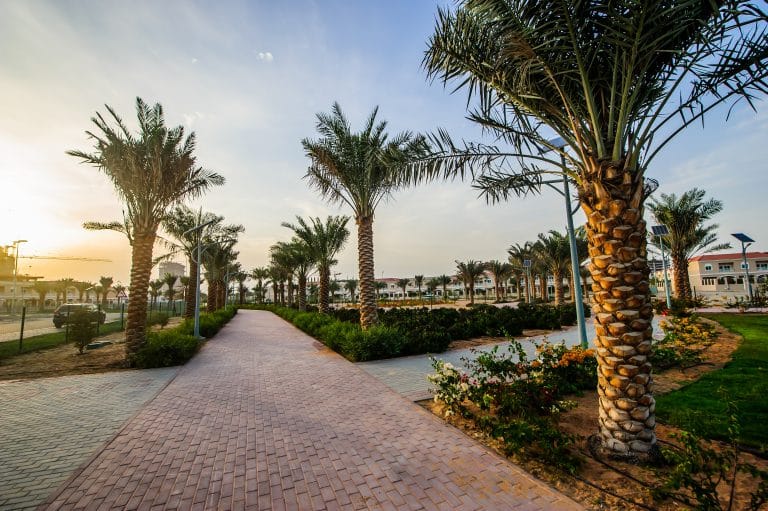
Villa and townhouse clusters carry private gardens in most Nakheel-built sub-communities, and the masterplan includes shared parks, cycling paths and community pools across the pavilions. It reads as a genuinely green, low-density layout compared with Dubai’s tower-heavy inner communities, which is a core part of its appeal to villa buyers.
Al Furjan’s mix of developers — Nakheel alongside Azizi, NED Al Ghurair and others — gives the community a genuinely wide choice of product and finish, so it is worth viewing the specific building or plot with your Fidu agent to find the specification that suits you. On returns, the mid-tier apartments lead Dubai at 7.69% on DLD data, while the villas at 4.56% are bought for space, Metro access and finish. And Al Furjan Metro Station on the Route 2020 extension is a fixed piece of infrastructure at the community’s edge — your agent can map the walk from any specific sub-cluster.
Al Furjan’s closest useful comparisons are Jumeirah Village Circle, a similarly mid-tier Nakheel-style freehold community, and Damac Hills, a comparable villa-and-townhouse freehold community. On yield, Al Furjan’s mid-tier apartments led Dubai in H1 2026 at 7.69%, ahead of JVC’s 7.15% in the same report and segment — a genuine, DLD-sourced edge. On transport, Al Furjan’s own Route 2020 Metro station is its clearest differentiator of the three. On villas specifically, Al Furjan’s H1 2026 average 3-bedroom price (AED 4,244,000, DLD transaction data) sits close to Damac Hills’ Bayut-listed average 3-bedroom asking price (AED 4,359,000, asking-price listings) — a similar entry point, though Damac Hills adds a golf-course identity that Al Furjan doesn’t try to compete with. Choose JVC for the widest apartment supply and a large retail anchor in Circle Mall. Choose Damac Hills for golf-frontage villa living and a longer-established luxury-villa track record. Choose Al Furjan for the combination few others offer: villa or townhouse space with a Metro station on your doorstep, plus Dubai’s strongest mid-tier apartment yield.
Al Furjan sits on Sheikh Zayed Road (E11) and Mohammed Bin Zayed Road (E311), giving fast road access in both directions. By car, Dubai Marina is roughly 15-20 minutes away, Downtown Dubai around 30 minutes, and Dubai International Airport (DXB) roughly 33-35 minutes; Al Maktoum International Airport is closer, at around 20 minutes, making Al Furjan noticeably better positioned for the newer airport than for DXB. Ibn Battuta Mall is about a 10-minute drive. For journeys that don’t need a car, Al Furjan Metro Station puts Expo City Dubai and the rest of the Red Line within direct reach — a genuine alternative that sets Al Furjan apart among comparable villa communities.
The strongest, most directly sourced case for Al Furjan is its mid-tier apartment yield: 7.69% in Bayut’s H1 2026 Dubai Sales Market Report, the highest of any mid-tier apartment area the report names, ahead of both Town Square and JVC. That’s a DLD-transaction-based figure rather than a listings estimate, which makes it a solidly grounded number. Villas make a different case: 4.56% ROI and 6.91% price growth over the same period, positioned around space and Metro access. The Metro station itself is a durable structural advantage — it’s a fixed piece of infrastructure, and it sets Al Furjan apart among Dubai’s mid-market villa-and-townhouse communities. Fidu will provide current, DLD-verified pricing for a specific building or plot, so you can act on a confirmed number rather than an area-wide average.
Villa sales, price-per-sq-ft and yield figures for Al Furjan: Bayut’s Dubai Sales Market Report H1 2026 (DLD transaction data, published 29 Jul 2026). Apartment sale and rent figures: Bayut’s Al Furjan property-market-analysis pages (a mix of DLD transaction data and asking-price listings, each labelled above), accessed 13 Aug 2026. Service charges are published per property on Mollak, RERA’s official platform, and your Fidu agent will confirm the exact rate for any unit you are considering.
1 property found
AED 1,800,000
 2 Bed
2 Bed
 2 Bath
 1131 sq-ft
Pearlz by Danube, Al Furjan, Dubai

Listing by
Ani Sarukhanyan