Dubai Land Residence Complex: Buying Guide, Prices & Listings
A multi-developer freehold apartment cluster in Dubailand at the Al Ain Road/Emirates Road junction, built on studio-to-3-bed towers rather than a single masterplan brand.
HandoverMixed — established towers built/occupied (mostly 2010s); active off-plan supply with staged handovers into 2027-2028
Highlights
About Dubai Land Residence Complex
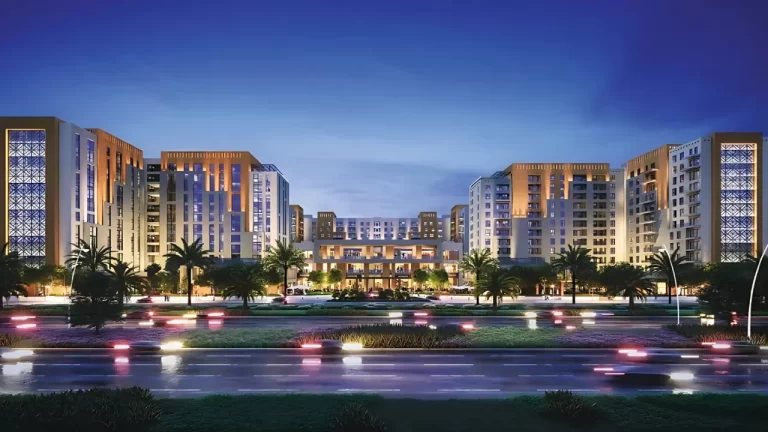
Dubai Land Residence Complex — commonly shortened to DLRC — is a specific, DLD-registered residential cluster sitting on the Wadi Al Safa 3, 4 and 5 land parcels at the junction of Dubai–Al Ain Road (E66) and Emirates Road (E611). It should not be confused with “Dubai Land” as a generic term for the sprawling Dubailand district that surrounds it: DLRC is one named, bounded sub-community inside that wider area, not a synonym for the whole district. Unlike a single-developer masterplan such as Arabian Ranches or Dubai Hills Estate, DLRC has no single owner-developer — it grew as a cluster of separately developed mid-rise towers, with Samana Developers, Tiger Group, Pantheon Development, Vincitore Realty, Azizi Developments, National Bonds Corporation and Sondos Holding among the more active contributors. That multi-developer model is the defining fact about the area: it explains the range of building ages and architectural styles on the ground, and the breadth of choice buyers have across towers and price points here.
Dubai Land Residence Complex in a nutshell
DLRC is a freehold, budget-to-mid-market apartment community aimed at buyers and tenants who want a lower entry price than the closer-in parts of Dubai, with direct access to the E66/E611 junction and fast road connections across the city. It is best suited to investors targeting the liquid studio-to-two-bedroom bracket and to end-users who value space for money, an on-site school and proximity to the Academic City and Silicon Oasis employment corridor. Several developers are building here at once, which keeps a steady flow of new stock and new amenities coming to the area.
Stock is dominated by studio-to-three-bedroom apartments in mid-rise towers rather than villas or townhouses. Established, occupied buildings include the six-tower Skycourts Towers development by National Bonds Corporation, Tiger Group’s V Tower, Durar 1, Blue Waves Tower, Etlala Residence and the mixed-use Desert Sun Tower, alongside Sondos Holding’s Sondos Lilac, Sondos Sage, Sondos Orchid and Sondos Lily buildings. Layered on top of that established stock is an active pipeline of newer towers from Samana Developers, Tiger Group, Pantheon Development, Vincitore Realty and Azizi Developments, with handovers staged across the next few years. There is no single named “sub-community” system the way Arabian Ranches or Dubai Hills Estate use phase names — buildings are generally referred to individually or by developer cluster.
Freehold status — who can buy
DLRC sits within the Dubailand freehold framework, registered with the Dubai Land Department under Regulation No. 3 of 2006, open to UAE nationals, GCC nationals and foreign investors alike, with full title deed registration and standard RERA escrow protection on off-plan purchases. As with any Dubai freehold purchase, confirm a specific unit’s registration status via the Dubai REST app or directly with DLD before signing.
Golden Visa eligibility
The property-investor Golden Visa requires a Dubai Land Department valuation of at least AED 2,000,000. DLRC’s accessible pricing means the Golden Visa route here is usually opened by a larger three-bedroom unit, a higher-end newer launch, or by combining more than one property into a qualifying portfolio — something the community’s entry prices make straightforward. Your Fidu agent will confirm the DLD valuation of a specific unit so you know exactly where it sits against the threshold.
Handover and completion status
DLRC is a mix of mature and active-construction stock at the same time. Skycourts Towers, V Tower, the Sondos cluster, Durar 1 and Desert Sun Tower are built out and occupied, most dating from the 2010s. Running alongside that established core is a genuinely large amount of newer off-plan activity from Samana Developers, Tiger Group, Pantheon Development, Vincitore Realty and Azizi Developments, with staged handovers reported into 2027 and 2028. Buyers of resale units in the established towers sit alongside an area still adding new homes, retail and infrastructure on neighbouring plots; buyers considering an off-plan unit here can browse Fidu’s current off-plan listings for live project options.
Sales trends and price per square foot
Bayut’s Dubai Land Residence Complex area guide, built from asking-price listings over the trailing 12 months, puts average apartment sale prices at AED 663,000 (studio), AED 975,000 (1-bed), AED 1,446,000 (2-bed) and AED 1,738,000 (3-bed) — among the most affordable apartment pricing of any area in this batch. Your Fidu agent can work out the per-square-foot figure for any specific unit from its price and floor area.
Rental trends and demand drivers
The same Bayut area guide puts average asking rents at AED 44,000 (studio), AED 61,000 (1-bed), AED 80,000 (2-bed) and AED 122,000 (3-bed), based on listings over the trailing 12 months. Demand is driven by tenants who want more space for their rent than the closer-in communities offer, with fast road access to the rest of the city — and the mix of studios and small one- and two-bedroom units gives landlords a deep, fast-moving tenant pool close to Academic City and Dubai Silicon Oasis.
Gross rental yield
Bayut’s own ROI calculation for DLRC, based on user searches over the trailing 12 months, puts apartment yields at 5.71%–6.85% depending on size — a solid, affordable-community-style return. This is a listings-and-search-based estimate; your Fidu agent can model the achievable yield on a specific unit using current comparables.
Service charges — what you’ll actually pay
Service charges here are set per building — a consequence of DLRC’s many independent developers — and are published per property on Mollak, RERA’s official service-charge platform. Your Fidu agent will confirm the exact current figure for any unit you are considering.
Transport and parking
DLRC is a road-connected community sitting directly on the E66/E611 junction, with Creek Metro Station on the Green Line roughly a 17-minute drive away. Rail coverage in the area is expanding: the RTA has confirmed the new Dubai Metro Blue Line for completion on 9 September 2029, adding 14 stations including ones serving Dubai Silicon Oasis and Dubai Academic City, both roughly 10 minutes from DLRC by car. In the meantime, the community sits directly on the E66/E611 junction, giving fast car access to Sheikh Mohammed Bin Zayed Road (E311) and onward to the rest of Dubai. Covered or basement parking is standard across the newer towers.
Schools and nurseries
The Aquila School sits inside DLRC itself, on the Wadi Al Safa 5 parcel. Checked directly on its KHDA profile (web.khda.gov.ae, Id=5509, CenterID=152599), the school’s curriculum is listed as International Baccalaureate, spanning FS1 to Year 13, and its most recent DSIB inspection (2023–2024) rated it Good overall — consistent with Good ratings in both the 2022–2023 and 2021–2022 cycles, with Very Good marks for Personal & Social Development and Health & Safety in the latest cycle. GEMS FirstPoint School, roughly 2km away in the neighbouring Villa community, was checked the same way (web.khda.gov.ae, Id=4439, CenterID=2261): it follows the UK curriculum and was rated Very Good overall in its 2023–2024 inspection, an improvement on Good ratings across every cycle from 2016–2017 through 2022–2023. For early years, Chubby Cheeks Nursery and Step by Step Nursery both operate within DLRC; nurseries are inspected under KHDA’s separate early-years framework rather than the DSIB school ratings above, and current details for each are published by KHDA.
Amenities, healthcare and everyday services
Everyday retail is dense and built into the towers themselves: supermarkets and mini-marts operating within DLRC’s buildings include West Zone Fresh Supermarket in Desert Sun Tower and Shua Al Madina Supermarket in Durar 1, alongside pharmacies, laundries, salons and an optician spread through ground-floor units. For clinic-level care, Ace Medical Centres (Skycourts) and Medicentres Polyclinic (Skycourt Tower D) operate inside the community, with Dubai London Clinic a short drive away in The Villa. For hospital-level care, residents typically drive to Mediclinic Parkview Hospital in Al Barsha South, roughly 20 minutes away. The nearest proper mall is Dubai Outlet Mall, about 15 minutes away, with more than 200 discount-retail outlets.
Lifestyle
Dining and retail
Dining and casual retail run through ground-floor units in the residential towers themselves — cafes, bakeries and fast-casual outlets within walking distance of home. For a bigger shopping and dining trip, Dubai Outlet Mall and its 200-plus outlets are roughly 15 minutes away by car, with central Dubai beyond it.
Landmarks and things to do
Global Village and IMG Worlds of Adventure are both roughly a 10-minute drive from DLRC, making the community a genuinely convenient base for residents who use either regularly during Global Village’s seasonal run or IMG Worlds’ four theme zones year-round. Al Barari, the landscaped villa community known for its botanical gardens and Farm restaurant scene, sits nearby as a reference point for the area’s more established, greener neighbour, though it is not part of DLRC itself.
Outdoor space
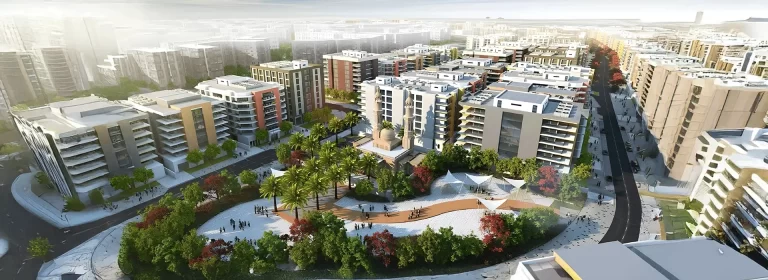
The masterplan distributes parks, plazas and mosques through the residential clusters, giving everyday green space within walking distance of the towers, with Al Barari’s landscaped botanical gardens close by in the neighbouring area.
What to know before you commit
DLRC is a road-first community, and that is what makes it work: it sits directly on the E66/E611 junction for fast access across the city, with Creek Metro Station about 17 minutes away and the confirmed Blue Line bringing stations to neighbouring Silicon Oasis and Academic City in 2029. Because several developers are building here at the same time, the area keeps adding homes and amenities, and buyers get a genuinely wide choice of towers, specifications and price points — viewing the specific building is the best way to find the one that fits. That steady flow of studio-to-two-bedroom stock is also what makes the rental market here so liquid, and your Fidu agent can show you where current supply and demand sit before you commit.
Location
How Dubai Land Residence Complex compares to Liwan and Al Warsan
The closest genuine comparison is Liwan, a Dubai Holding-developed freehold community roughly 13 million sq ft in size at the E311/E66 junction, a short drive further south. Liwan was built by a single masterplan developer and markets itself on proximity to Academic City schools and green space; DLRC answers with its own on-site school (The Aquila School), a wider spread of buildings and developers to choose from, and a lower general entry price. Al Warsan is the other useful reference point — a similarly budget-positioned freehold cluster (particularly its Warsan 4/International City Phase 2 pocket) near Ras Al Khor Road and Emirates Road, anchored by Dragon Mart rather than a mall, and generally priced below both DLRC and Liwan. Choose Liwan for single-developer consistency and a stronger schools-and-green-space pitch; choose Al Warsan for the lowest entry price of the three and Dragon Mart’s retail draw; choose DLRC for a school inside the community itself and the widest current spread of active off-plan launches.
Getting to and from Dubai Land Residence Complex
DLRC sits directly on the E66/E611 junction, with Sheikh Mohammed Bin Zayed Road (E311) a short drive further on. Downtown Dubai and Business Bay are both a reasonable estimate of around 20–25 minutes by car depending on traffic; Dubai International Airport runs somewhat longer, roughly 25–30 minutes, while Al Maktoum International Airport (DWC) is a broadly similar drive in the other direction. Dubai Silicon Oasis and Dubai Academic City are both close, at around 10 minutes — relevant given the Blue Line stations planned for both by 2029. These are typical-traffic estimates, consistent with how drive times are presented across Fidu’s other area guides, with the E66/E611 junction on the doorstep making all of them straightforward drives.
Is Dubai Land Residence Complex a good investment?
On Bayut’s listings-based figures, DLRC’s apartment yields (5.71%–6.85% depending on size) sit in a solid, affordable-community range. The community’s draw is a lower entry price than most freehold alternatives closer to central Dubai, an on-site school, and continued active interest from several developers currently building here. That same developer activity keeps a steady stream of studio-to-two-bedroom stock coming to market, which is what underpins the community’s liquidity for both resale and letting. The ROI figures above are listings-and-search-based estimates, and your Fidu agent will pull current pricing for a specific building or unit so you are working from live numbers.
FAQs about Dubai Land Residence Complex
Is Dubai Land Residence Complex freehold?
Yes — it sits within the Dubailand freehold framework under Regulation No. 3 of 2006, open to UAE nationals, GCC nationals and foreign investors.
What does a 2-bed apartment cost in DLRC?
Bayut’s listings-based average is around AED 1,446,000 to buy or AED 80,000 a year to rent, as of mid-2026 — asking prices from live listings, not confirmed DLD transactions.
How is DLRC connected?
By road, from the E66/E611 junction it sits on, with Creek Metro Station (Green Line) about a 17-minute drive away. The Blue Line, confirmed for completion on 9 September 2029, adds stations at neighbouring Dubai Silicon Oasis and Dubai Academic City, both around 10 minutes away by car.
Are there schools in the community?
Yes — The Aquila School sits inside DLRC and was rated Good by KHDA in its most recent (2023–2024) inspection. GEMS FirstPoint School, about 2km away in The Villa, was rated Very Good in the same cycle.
What’s the community built around?
DLRC is a cluster of towers from multiple developers (Samana, Tiger Group, Sondos Holding, National Bonds Corporation and others), which gives buyers an unusually wide choice of buildings, specifications and price points in one location.
Is it still under construction?
Partly. Established towers like Skycourts, V Tower and the Sondos buildings are fully occupied, while several developers have active off-plan launches with handovers staged into 2027 and 2028.
How does it compare to Liwan?
Liwan is a single-developer masterplan with a schools-and-green-space pitch; DLRC spans several developers, has its own on-site school and generally lower entry prices.
Al Warsanlowest entry price of the three, anchored by Dragon Mart
Sources and methodology
Sales, rental and ROI figures are drawn from Bayut’s Dubai Land Residence Complex area guide, based on live listings and user searches over the trailing 12 months. Service charges in DLRC are set per building and published per property on Mollak, RERA’s official platform, which is where Fidu confirms the current rate for a specific unit.
Sales, rental and ROI figures: Bayut’s Dubai Land Residence Complex area guide, based on live listings and user searches over the trailing 12 months, accessed 13 Aug 2026 — bayut.com/area-guides/dubai-land-residence-complex.
Freehold status: Regulation No. 3 of 2006, Dubai Land & Property Department — dlp.dubai.gov.ae.
Golden Visa threshold: AED 2,000,000 DLD property valuation threshold.
Schools: KHDA’s own school directory and published DSIB inspection history, checked directly at web.khda.gov.ae — The Aquila School (Id=5509, CenterID=152599) and GEMS FirstPoint School (Id=4439, CenterID=2261), 2023–2024 cycle and prior years, accessed 13 Aug 2026.
Metro: RTA’s confirmed Dubai Metro Blue Line completion date of 9 September 2029 and its station list, as reported via RTA’s public announcement.
Developer and building names, sub-community composition, amenity counts, and masterplan history: general real-estate research and portal pages used only to verify non-price facts (developer names, building names, distances to landmarks), cross-checked across more than one source and never used as the source for any price, rent, yield or service-charge figure.
Transport and drive times: road access via Dubai–Al Ain Road (E66) and Emirates Road (E611). Drive times to landmarks and airports are typical-traffic estimates, not a single named published dataset, consistent with how drive times are presented across Fidu’s existing area guides.
Where a figure could not be tied to one of these named, dated sources, it is described qualitatively rather than estimated.
Properties for sale in Dubai Land Residence Complex
We use cookies to understand which properties you view, so the adverts you see elsewhere are
relevant rather than random. Decline and the site works exactly the same — we simply
stop measuring. Privacy Policy

 1 Bed
1 Bed
 2 Bath
 686 sq-ft