Areas
Al Quoz: Buying Guide, Prices & Listings
Dubai's largest industrial and warehouse district, now also home to the Alserkal Avenue arts scene and a small but genuine freehold residential layer.
Areas
Dubai's largest industrial and warehouse district, now also home to the Alserkal Avenue arts scene and a small but genuine freehold residential layer.
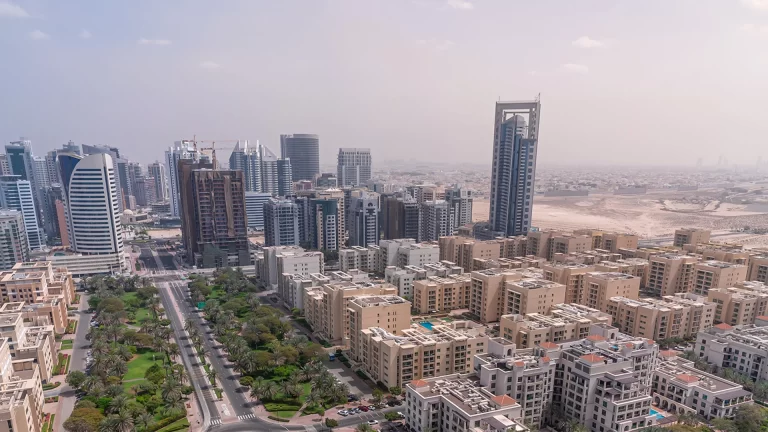
Al Quoz is a 27.1 sq km rectangular stretch of Dubai wedged between Sheikh Zayed Road (E11) and Al Khail Road (E44), and it is, first and foremost, one of the emirate’s oldest and largest industrial districts, per Bayut’s own Al Quoz area guide. Dubai Municipality divides it into a residential northeast — Al Quoz 1, Al Quoz 2 and Al Quoz 4 — and a commercial south made up of Al Quoz 3 and the four Al Quoz Industrial Areas, home to factories, auto workshops, warehouses and showrooms. What makes Al Quoz genuinely unlike any other Fidu guide area is that its best-known identity today has nothing to do with either of those zonings: Alserkal Avenue, a cluster of more than 70 contemporary art galleries, design studios and cultural venues founded in 2007 inside a grid of converted warehouses in Al Quoz Industrial Area 1, per Dubai Culture and Arts Authority’s own profile of the district. Dubai’s government has since formalised that shift with the Al Quoz Creative Zone, a Dubai 2040-linked masterplan approved by the Higher Committee of the Al Quoz Creative Zone on 2 October 2022, which aims to grow the district’s resident creative population from roughly 900 to 20,000 people, house more than 8,000 residents, attract 33,000 daily visitors and deliver 2,900 below-market housing units earmarked for creatives, per Khaleej Times’ own reporting on the approval.
Al Quoz is a genuinely distinctive Dubai address, and it rewards understanding which of its three property markets you are shopping in. Three genuinely distinct property types exist here: standard studio-to-4-bedroom apartments and a smaller run of villas and townhouses concentrated in the residential pockets of Al Quoz 1, Al Quoz 2 and Al Quoz 4 (chiefly the Al Khail Heights and Al Khail Gate compounds); a fast-growing market of warehouse-to-loft conversions inside the industrial sector, aimed at artists, designers and creative professionals drawn by Alserkal Avenue and the Creative Zone; and, by far the largest slice of the district by land area and transaction volume, commercial stock — warehouses, showrooms, offices and industrial land — which is a substantial market in its own right. Your Fidu agent will make clear which of these three markets any given listing sits in.
Bayut’s own area guide names Al Quoz 1, Al Quoz 2 and Al Quoz 4 as the residential sub-communities, with Al Quoz 4 the most active for both renting and buying — it holds the Al Khail Heights and Al Khail Gate compounds, the district’s closest thing to a conventional strata apartment and townhouse market, alongside spacious villas. Al Khail Heights, developed by Texture Holding Ltd. and handed over from 2015, comprises 58 townhouses and 26 low-rise apartment buildings running from studios to five-bedroom units, with shared pools, gyms and sports courts. Al Quoz 2 and Al Quoz 3 are described by Bayut as third and fourth in popularity. The Al Quoz Industrial Areas 1 to 4 are Dubai Municipality’s commercial and industrial zoning, and Bayut’s own guide ranks the Industrial Area as the second most popular sub-community for renting and buying overall — with that popularity driven by the district’s warehouses, offices and showrooms. Within that industrial fabric, Al Quoz Industrial Area 1 hosts Alserkal Avenue and a genuine, if small, scene of converted warehouse lofts — live-work spaces with double-height ceilings that Bayut’s own live rental listings show reaching up to AED 525,000 a year for the most premium designer units with private pools, well above the standard apartment range described below. The loft market here is a genuinely emerging segment, priced building by building — your Fidu agent can source current availability and pricing for any specific conversion you are considering.
Dubai’s designated-area list under Regulation No. 3 of 2006 has been widened several times since, and Al Quoz’s residential compounds are actively marketed and sold to non-UAE nationals today, including via DLD-registered title transfers, per multiple brokerage listings for Al Khail Heights. The exact ownership structure at Al Khail Heights and Al Khail Gate — full freehold title, or a long-term right commonly cited as up to 99 years — is set out on the individual title deed, and your Fidu agent will confirm it with the Dubai Land Department or via the Dubai REST app for any unit you are considering. Separately, the larger part of Al Quoz’s land — the Al Quoz Industrial Areas, including Alserkal Avenue itself — sits on Dubai Municipality commercial zoning, where space is leased on commercial terms, a distinct and active market of its own.
The property-investor Golden Visa requires a Dubai Land Department valuation of at least AED 2,000,000. On Bayut’s own DLD-derived transaction data (detailed below), larger apartments, villas (from around AED 3.1 million) and residential plots (AED 3.2 million to AED 4.8 million) generally clear that threshold. Your Fidu agent will confirm the specific unit’s DLD valuation and ownership structure to support an application.
The residential compounds are mature and occupied: Al Khail Heights has been handing over units since 2015, and Al Quoz 1, 2 and 4 more broadly are long-established, built-out neighbourhoods rather than active construction sites. What’s genuinely in motion is the Creative Zone masterplan itself — approved October 2022, with infrastructure works (transport links, pedestrian and cycling paths, three transport hubs), public realm and art-installation phases still rolling out, per Khaleej Times’ reporting on the approval. The Creative Zone’s transport links, pedestrian and cycling paths, public realm and art installations will continue to be delivered around Alserkal Avenue and the wider district over the next several years — a substantial government-backed upgrade to the area, delivered around residential pockets that are already settled.
Bayut’s Al Quoz area guide, whose figures the site states are built from DLD transaction data with outliers cleaned out, recorded 121 apartment sale transactions in the trailing 12 months totalling AED 87.4 million, and 494 villa sale transactions totalling AED 8.1 billion (that villa figure reflects the district’s mixed residential-and-large-plot market rather than a conventional villa community). By unit size: studios sold for AED 480,000 to AED 670,000; 1-beds for AED 690,000 to AED 1.05 million; 2-beds for AED 1.19 million to AED 1.88 million; 3-beds around AED 1.9 million; 4-beds AED 1.8 million to AED 2.1 million; and 5-bed apartments around AED 2 million. Villas ran from AED 3.1 million (5-bed) to AED 3.8 million (4-bed) and AED 3.2 million (6-bed), with 5-bed townhouses also around AED 3.1 million and residential plots AED 3.2 million to AED 4.8 million. Your Fidu agent can supply a current price-per-square-foot figure for any specific building or compound you are considering.
The same DLD-derived Bayut data recorded 12,146 apartment rent transactions in the trailing 12 months, totalling AED 569.9 million — a genuinely large rental market for the area. Studio rents ran AED 39,000 to AED 85,000 a year; 1-beds AED 60,000 to AED 78,000; 2-beds AED 45,000 to AED 85,000; and 3-beds around AED 84,000. Villa rents ranged from AED 200,000 to AED 500,000 (4-bed) up to AED 220,000 to AED 1.5 million (5-bed) and AED 280,000 to AED 750,000 (6-bed). Separately, Bayut’s live rental listings for Al Quoz — an asking-price snapshot, not a transaction figure — show the same standard-apartment bands (studios roughly AED 45,000–54,000, 1-beds AED 55,000–70,000, 2-beds AED 63,000–115,000) alongside a distinct tier of premium designer lofts in Al Quoz Industrial Area 3 asking up to AED 525,000 a year, underlining how far the loft segment sits outside the conventional apartment market. Demand is split between residents who want more space for the money within reach of Sheikh Zayed Road and Business Bay, and a specific, smaller pool of tenants drawn by Alserkal Avenue and the Creative Zone’s studio-and-gallery ecosystem.
Bayut’s own ROI figures for Al Quoz, built from the same DLD-derived dataset, put studio apartments at the top with a 9.52% yield, 1-beds at 8.82%, 2-beds at 6.51%, and 5-bed villas at 5.38%. These are genuinely strong numbers by Dubai standards, drawn from Bayut’s DLD-derived dataset of Al Quoz apartment sales over the past 12 months. Your Fidu agent can model the return on a specific unit, including in the warehouse-loft segment, against its actual purchase price and achievable rent.
Service charges in Al Quoz vary by building and are published per property on Mollak, RERA’s official service-charge platform — your Fidu agent will confirm the exact figure for any unit you are considering, whether a converted warehouse loft or a standard Al Khail Heights apartment.
Per Bayut’s own area guide, Al Quoz is served by Onpassive Metro Station on the Red Line, roughly a 10-minute drive away. The nearest bus stops cited are Madinat Jumeirah 1 & 2 and Burj Al Arab Hotel 1 & 2, both 17 to 19 minutes away by car, in a district that sits centrally between Sheikh Zayed Road and Al Khail Road with direct access to both. Apartment buildings offer dedicated parking and villas come with covered spots. Al Quoz remains one of Dubai’s largest working commercial districts alongside its residential pockets, with Sheikh Zayed Road and Al Khail Road running along its two long edges.
Three schools genuinely operate inside Al Quoz today, and Fidu verified each rating directly against KHDA’s own School-Details pages rather than taking an aggregator’s word for it. Clarion School, in Al Quoz 1, follows an American curriculum built on the Bank Street Developmental Interaction Approach and was rated Good by KHDA for 2023–2024. GEMS Our Own Indian School, also in Al Quoz 1 and serving the community since 1991, follows the Indian (CBSE) curriculum from KG1 to Grade 12 and was rated Very Good by KHDA for 2023–2024. Oak Tree Primary School, at Al Khail Mall in Al Quoz 4, follows the UK curriculum for ages 3 to 11 and was rated Acceptable by KHDA for 2023–2024. Safa British School, sometimes still listed under Al Quoz, moved to a purpose-built campus in Al Safa 1 in 2020 after an interim Al Quoz site from 2012. For younger children, Bayut’s guide points families to a cluster of nurseries in neighbouring Al Barsha 2, including Dewdrop, Cherry Town and Seashells. For higher education, Jumeira University sits inside Al Quoz 4 on Latifa Bint Hamdan Street, a private institution with a roughly 3,000-student campus completed in 2009; Dubai Knowledge Park’s larger university cluster (Heriot-Watt, Murdoch, Middlesex, University of Wollongong Dubai) is a 16-to-19-minute drive away.
Oasis Centre, in Al Quoz 1, is the district’s own mall — retail, dining and the Fun City theme park under one roof — with Mall of the Emirates a short drive away in neighbouring Al Barsha for a much larger selection, including Ski Dubai and VOX Cinemas’ laser IMAX screen. Everyday grocery shopping runs through a scatter of independent supermarkets — Jubily, Sky Star and Abdallah Ketait in Al Quoz 4, plus Sultan Al Madina, Najmath Al Madina and Azhr Al Madina elsewhere in the district — with West Zone Supermarket, popular for fresh and organic produce, about seven minutes away. On healthcare, Aster Clinic, Medilife Polyclinic, Toronto Medical Center and several smaller polyclinics operate within Al Quoz itself; for hospital-level care, Burjeel Hospital for Advanced Surgery sits on Sheikh Zayed Road close to Alserkal Avenue, about a 10-minute drive, and is used mainly for orthopaedic treatment, per Bayut’s own guide.
Al Quoz’s roughly 200 eateries are strong on authentic, everyday dining — Sabir Afghan Restaurant, Royal Darbar, Madras Kitchen at Al Khail Gate, Chennai Darbar and Shehar-e-Karachi among them, serving Indian, Pakistani and Arabian cuisine across the district. Alserkal Avenue supplies the more design-led end of the spectrum, with Tom & Serg, Lime Tree Restaurant, Nizar Restaurant and Cafe and Soho Cafe all sitting inside or near the gallery district, plus Cinema Akil for arthouse and independent film. For bigger retail trips, Mall of the Emirates in Al Barsha is roughly 12 minutes away.
Alserkal Avenue is the defining landmark — 500,000 sq ft of converted warehouses housing more than 70 galleries, arts organisations and creative businesses, founded in 2007 and now the anchor of the wider Al Quoz Creative Zone masterplan. Majlis Ghorfat Um-Al Sheif, a 1955 vacation home built for the late Sheikh Rashid bin Saeed Al Maktoum, is the district’s historical counterpoint. Families are served by Dubai’s First Experiential Play Museum in Al Quoz 1, an interactive children’s learning centre with climbing nets and water play. Al Khail Gate also hosts a monthly first-Friday market with a carnival atmosphere for residents.
Al Quoz Pond Park is the district’s main green space — built around an artificial pond that attracts birdlife, and the natural choice for families. Al Quoz Park 3 adds a neighbourhood volleyball court nearby. Kite Beach, roughly 12 minutes away, is the nearest beach. Al Khail Heights’ own grounds — pools, gyms and landscaped courtyards shared across its 58 townhouses and apartment buildings — cover most day-to-day outdoor amenity for residents of that specific compound.
Al Quoz is a genuinely working district as well as a residential one, and it is exactly that character that gives Alserkal Avenue and the Creative Zone their setting. Onpassive Metro Station on the Red Line is about ten minutes away, with Sheikh Zayed Road and Al Khail Road running along both long edges for direct access across the city. Al Quoz Pond Park, Al Khail Heights’ own pools, gyms and landscaped courtyards, and Kite Beach twelve minutes away cover outdoor life. On ownership, your Fidu agent will confirm the exact structure of any specific unit with the Dubai Land Department, and can source current pricing in the warehouse-loft segment, which is still building its public track record.
Al Quoz sits directly between two very different neighbours, per Bayut’s own boundary description — Al Barsha to the west and Business Bay to the east, with Al Wasl and Umm Suqeim 1 completing its borders. Against Al Barsha, the comparison is really “industrial-and-creative versus conventional residential and retail”: Al Barsha carries Mall of the Emirates and a mature, purely residential apartment market, while Al Quoz adds lower entry prices, the Alserkal Avenue cultural scene and a genuinely mixed-use, creative-district character of its own. Against Business Bay, the contrast is sharper — Business Bay is a dense, Metro-connected high-rise business and residential district with an established skyline, while Al Quoz stays low-rise, with a more affordable residential product and a creative-district identity of its own. Choose Al Barsha for mall-adjacent, conventional apartment living; choose Business Bay for a Metro-connected, high-density urban address; choose Al Quoz for the lowest entry prices of the three, genuine creative-district character, and a residential market with real momentum behind it.
Sheikh Zayed Road (E11) and Al Khail Road (E44) run along Al Quoz’s two long edges, giving direct access to most of the city. Per Bayut’s own figures, Downtown Dubai and the Burj Khalifa are about a 10-minute drive away, Mall of the Emirates around 12 minutes, and Dubai International Airport roughly 25 minutes. The Onpassive Metro Station on the Red Line is the nearest rail option, about a 10-minute drive from most of the district.
On Bayut’s own DLD-derived figures, the headline numbers are genuinely attractive — apartment yields as high as 9.52% for studios and 8.82% for 1-beds, well above what most established Dubai communities offer, and entry prices from AED 480,000 for a studio are among the lowest of any Fidu guide area. The case for Al Quoz is a case for two kinds of buyer: a value-focused investor buying Al Khail Heights-style apartments at a genuine discount to nearby Al Barsha and Business Bay, or a longer-horizon investor backing the government-approved Al Quoz Creative Zone masterplan, which targets 8,000-plus residents and 20,000 creatives. Fidu will confirm current, DLD-verified pricing and ownership status for any specific unit, and can source pricing in the loft-conversion segment, which is still building its public track record.
Al Quoz’s sale, rental and ROI figures come from Bayut’s own Al Quoz area guide, which the site states is built from Dubai Land Department transaction data with outliers removed — a DLD-derived source, not a raw asking-price average — last published 9 September 2025 and accessed by Fidu on 13 Aug 2026. Where Fidu also cites Bayut’s live listing pages (for the loft-rental range and general apartment-rent bands), those are labelled as listings-based asking prices, not transactions, per Fidu’s standing rule to separate the two. Service charges are published per property on Mollak, RERA’s official platform, and your Fidu agent will confirm the exact rate, the ownership structure of any specific unit at Al Khail Heights or Al Khail Gate, and current pricing in the warehouse-loft segment.
No properties found in Al Quoz at the moment.