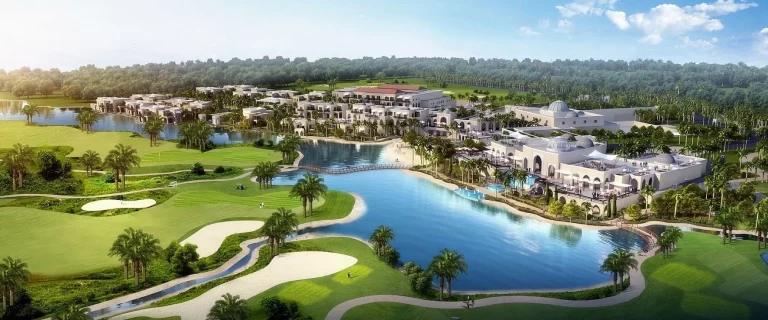
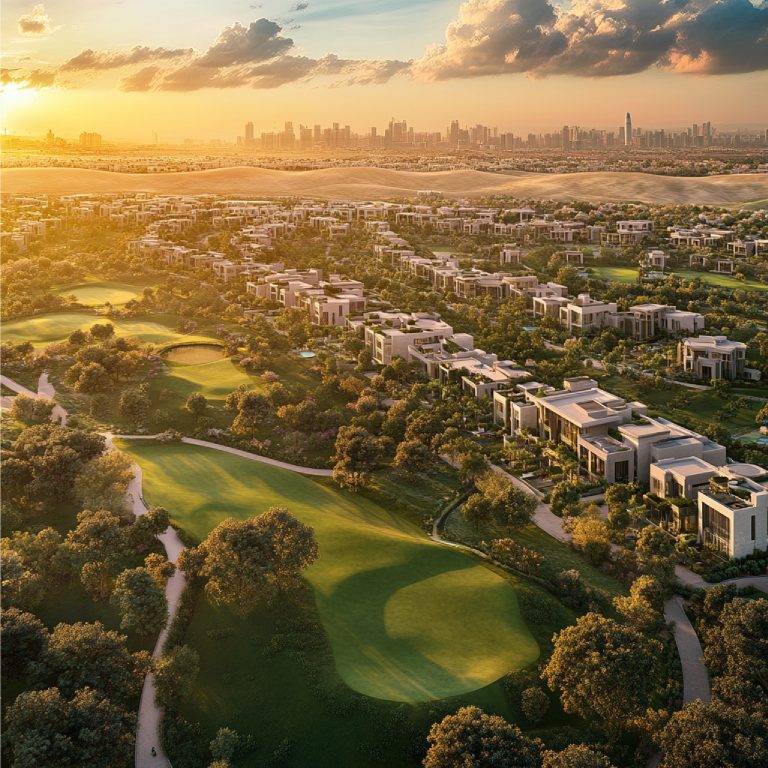
A golf-course villa community off Sheikh Mohammed Bin Zayed Road, built around two Greg Norman championship courses and now expanding under wasl's Next Chapter masterplan.
HandoverOriginal estate largely complete by mid-2010s; "Next Chapter" expansion under construction, handovers from Q4 2028
Highlights
About Jumeirah Golf Estates
Jumeirah Golf Estates (JGE) is a gated, low-density villa community built around two Greg Norman-designed championship golf courses — Earth and Fire — off Sheikh Mohammed Bin Zayed Road (E311), between Dubai Sports City and Motor City. The estate was established in 2009 and most of its original sub-communities, such as Redwood, Al Andalus, Whispering Pines, Sanctuary Falls and Flame Tree Ridge, were built out through the 2010s as low-rise villas and townhouses set around fairways and water features.
The Earth Course is JGE’s headline asset: it has hosted the DP World Tour Championship, the season-ending event of the DP World Tour’s Race to Dubai, since 2009, giving the community a genuine tournament-golf pedigree that few other Dubai addresses can claim. In May 2025, master developer wasl — a Dubai government-backed developer — unveiled “The Next Chapter,” a 4.68 million sqm expansion adding six new districts (Central Park, Village, Town Centre & Grand Lake, Golf Course North, Golf Course South and Equestrian Village) around the existing estate, with handover on the new phases running from Q4 2028.
Jumeirah Golf Estates in a nutshell
Freehold villa and townhouse community, open to UAE and international buyers.
Anchored by two 18-hole championship courses — Earth (par 72, roughly 7,700 yards) and Fire (par 72, roughly 7,480 yards) — both designed by Greg Norman.
Has its own Dubai Metro station on the Route 2020 (Red Line) extension, opened June 2021.
Original estate spans well over a dozen named sub-communities of villas and townhouses; a further six districts are under construction as part of wasl’s “The Next Chapter” masterplan, with first handovers from Q4 2028.
Served by neighbouring Motor City and Dubai Sports City for schools, supermarkets and healthcare, all within a five-to-twenty-minute drive.
Neighbourhood
Property types and sub-communities
The original estate is almost entirely detached villas and townhouses, typically 3 to 6 bedrooms with private gardens and, in most cases, private pools. Sub-communities carry distinct architectural themes set by the master developer: Redwood and Flame Tree Ridge lean Mediterranean and Tuscan, with stone facades and terracotta roofs; Al Andalus is built around a shared Andalusian-style courtyard and plaza; Whispering Pines and Sanctuary Falls sit directly on the Fire and Earth fairways. The newer Pinewood Estate Homes and Ashwood Estates districts, released as part of the expansion, are contemporary-styled 3- and 4-bedroom villas and townhouses, sold as freehold to both UAE nationals and international investors.
The Next Chapter expansion widens the mix considerably: alongside more villas and townhouses, wasl’s own masterplan includes a large community park (the Central Park District, around 4.1 million sq ft) and a Town Centre & Grand Lake district, which points to apartments and retail-anchored buildings being added to what has, until now, been an almost entirely low-rise villa community. Buyers interested in the off-plan phases can browse current availability on Fidu’s off-plan listings.
Freehold status — who can buy
Jumeirah Golf Estates sits within Dubai’s designated freehold zones under Regulation No. 3 of 2006, Dubai Land & Property Department, meaning both UAE nationals and foreign nationals can hold full ownership title to property here, with no local-partner or leasehold structure required.
Golden Visa eligibility
The UAE’s property-investor Golden Visa route requires a DLD property valuation of at least AED 2,000,000. Jumeirah Golf Estates is generally positioned at the upper end of Dubai’s villa market — most original units are multi-bedroom detached villas on golf-course plots — so a meaningful share of resale properties here are likely to clear that threshold on their own. Values vary by sub-community, plot size and finish, so your Fidu agent will confirm the DLD valuation on the specific unit and can shortlist the configurations that clear the threshold comfortably.
Handover and completion status
The original estate is a mature, largely built-out community — construction across most of its founding sub-communities was substantially complete by the mid-2010s. The picture is different for the new districts: wasl launched “The Next Chapter” masterplan in May 2025 and, per the developer’s own project listing, is handing over the new phases from Q4 2028 onward. In practical terms, that means anyone buying into the established sub-communities today is buying a finished, occupied property, while anyone buying into the new districts is buying off-plan into a wasl-delivered programme with handover from Q4 2028.
Sales trends and price per square foot
Bayut’s Jumeirah Golf Estates area guide, built from asking-price listings over the trailing 12 months, puts average apartment sale prices at AED 1,391,000 (1-bed), AED 2,371,000 (2-bed), AED 3,142,000 (3-bed) and AED 6,728,000 (4-bed) — villa pricing is quoted per property, and your Fidu agent will pull current comparables for any sub-community you are considering. Separately, Bayut’s citywide Sales Market Report H1 2026 names Jumeirah Golf Estates as the top luxury-segment villa community for ROI at 6.04%, a DLD-derived figure. Per-square-foot rates vary by sub-community and plot; your Fidu agent will provide the current figure for any villa you are considering.
Rental trends and demand drivers
The same Bayut area guide puts average asking rents at AED 98,000 (1-bed), AED 143,000 (2-bed), AED 205,000 (3-bed) and AED 368,000 (4-bed) apartments, based on listings over the trailing 12 months. Demand is driven by buyers and tenants seeking golf-course frontage and villa-community privacy within reach of Dubai’s central corridor.
Gross rental yield
Bayut’s own ROI calculation, based on user searches over the trailing 12 months, puts villa yields at 6.97%–8.46% depending on size and apartment yields at 6.01%–6.90% — both higher than the citywide Sales Market Report’s separately-reported 6.04% luxury-villa-segment average, since search-based ROI and the report’s transaction-based ROI are calculated differently. Read together, they place Jumeirah Golf Estates at the strong end of Dubai’s luxury villa market for return.
Service charges — what you’ll actually pay
Service charges vary by sub-community and villa type and are published per property on Mollak, RERA’s official service-charge platform — your Fidu agent will confirm the exact figure for any home you are considering.
Transport and parking
Jumeirah Golf Estates has its own Dubai Metro station — Jumeirah Golf Estates Metro Station — on the Route 2020 Red Line extension that opened in June 2021 to connect Jabal Ali to the former Expo 2020 site. The station sits at the junction of Sheikh Mohammed Bin Zayed Road (E311) and the D57 corridor, giving the estate a metro connection that most Dubai villa communities simply don’t have. In practice it complements the car rather than replacing it — the estate is spread out and low-density, with the golf courses and clubhouses set in their own grounds. Road access is via E311 and Al Qudra Road. Parking is a non-issue for owners — villas come with private driveways and, in most sub-communities, attached garages.
Schools and nurseries
Jumeirah Golf Estates is served by two strongly rated schools a five-to-ten-minute drive away in neighbouring communities, both verified directly on KHDA’s own school directory:
Victory Heights Primary School (Dubai Sports City) — UK curriculum, rated Outstanding overall in its most recent (2023–2024) DSIB inspection. Verified at web.khda.gov.ae.
GEMS Metropole School – Dubai Branch (Motor City) — UK curriculum through Year 13, rated Good overall in its most recent (2023–2024) DSIB inspection, with Very Good ratings for wellbeing and inclusion. Verified at web.khda.gov.ae.
Separately, wasl’s own materials for the Pinewood and Ashwood districts describe an international school planned within the new expansion.
Amenities, healthcare and everyday services
The community’s social life runs through its two golf clubhouses, which together cover more than 12,000 sqm and hold the estate’s main restaurants, gyms, pools and tennis facilities. Everyday shopping sits a short drive away in neighbouring Motor City and Dubai Sports City, which is part of what keeps the estate itself low-density. For healthcare, Emirates Hospitals Group operates a day-surgery and clinic facility in neighbouring Motor City; larger hospitals such as Al Zahra Hospital and American Hospital’s Al Barsha facilities are roughly 15–20 minutes away by car. Beyond the clinics and the clubhouses, Motor City, Dubai Sports City and Mall of the Emirates are all around 20 minutes away by car.
Lifestyle
Dining and retail
Dining in Jumeirah Golf Estates is concentrated in the two clubhouses, which is exactly what a golf-first, low-density layout delivers: restaurants minutes from the front door rather than a busy retail street. Recent clubhouse listings include an Italian restaurant, a UK-style gastropub, and poolside and terrace dining overlooking the Earth course. Beyond the clubhouses, Motor City and Dubai Sports City cover cafes, supermarkets and everyday retail, both a short drive away.
Landmarks and things to do
The estate’s defining landmark is the golf itself: the Earth and Fire courses, and the Earth Course’s role as host of the DP World Tour Championship, the Race to Dubai’s season finale, since 2009. Next door in Motor City, the Dubai Autodrome hosts motorsport events and karting, and Dubai Studio City adds a production and media backdrop to the immediate area. Dubai Miracle Garden and Dubai Butterfly Garden, in Al Barsha South, are roughly a 15–20 minute drive away.
Outdoor space
Outdoor space here means golf-course frontage and private gardens rather than public parks — most existing villas back directly onto a fairway or a landscaped buffer. That changes with the expansion: wasl’s Central Park District, part of “The Next Chapter,” is planned as a roughly 4.1 million sq ft community park at the north of the new development, the first large shared green space built specifically for public use rather than course frontage.
What to know before you commit
A few things are worth knowing before you view. Jumeirah Golf Estates is one of very few Dubai villa communities with its own Metro station, and it still lives like a low-density golf address — schooling, groceries and clinics are handled by neighbouring Motor City and Dubai Sports City, five to twenty minutes away. A substantial part of what is sold as Jumeirah Golf Estates today is the Next Chapter expansion, handing over from Q4 2028, so buyers there are buying off-plan in a wasl-delivered masterplan. On price, rent, yield and service charges, your Fidu agent will pull current, transaction-backed figures for the specific sub-community and unit type you are considering.
Location
How Jumeirah Golf Estates compares to DAMAC Hills and Dubai Hills Estate
All three are Dubai’s best-known golf-anchored master communities, but they’re not interchangeable. DAMAC Hills is built around Trump International Golf Club Dubai and is larger and more mixed in unit type — villas, townhouses and apartments together — with a generally more accessible price positioning than JGE’s original villa-only core. Dubai Hills Estate, an Emaar–Meraas joint venture with its own Troon-managed golf course, is the most urban of the three: it already has a mall, schools and healthcare built into the community itself, and sits closer to Al Khail Road and central Dubai. Jumeirah Golf Estates differentiates itself on golf pedigree — two tournament-calibre Greg Norman courses hosting a DP World Tour event — and on low density, with retail, schools and healthcare a short drive away in neighbouring Motor City and Dubai Sports City, and its own Metro station on the doorstep.
Getting to and from Jumeirah Golf Estates
Jumeirah Golf Estates sits on Sheikh Mohammed Bin Zayed Road (E311), with secondary access via the D57 corridor and Al Qudra Road, and its own Route 2020 Red Line metro station. As typical drive-time estimates: Downtown Dubai and Burj Khalifa are about 25–30 minutes via E311 and Sheikh Zayed Road; Dubai Marina is around 20–25 minutes; Dubai International Airport (DXB) is roughly 30–35 minutes; and Al Maktoum International Airport (DWC) is closer, at around 20–25 minutes.
Is Jumeirah Golf Estates a good investment?
The underlying case has real substance: a genuine tournament-golf address, a rare metro connection for a villa community, low density, and continued backing from a government-linked master developer expanding the estate through 2028 and beyond. Those are structural positives that don’t depend on a single year’s price data. On the numbers, Bayut’s citywide Sales Market Report H1 2026 — a DLD-derived source — ranks Jumeirah Golf Estates top of Dubai’s luxury villa segment for ROI at 6.04%, and your Fidu agent will pull current, transaction-backed comparables for the specific sub-community and unit type so you are pricing from real deals.
FAQs about Jumeirah Golf Estates
Is Jumeirah Golf Estates freehold?
Yes. It sits within Dubai’s freehold zones under Regulation No. 3 of 2006, open to both UAE nationals and foreign buyers.
Does Jumeirah Golf Estates have a Metro station?
Yes — Jumeirah Golf Estates Metro Station opened in June 2021 as part of the Route 2020 Red Line extension, at the junction of Sheikh Mohammed Bin Zayed Road (E311) and D57.
Are there schools in Jumeirah Golf Estates?
Two strongly rated schools sit close by: Victory Heights Primary School (Outstanding, Dubai Sports City) and GEMS Metropole School – Dubai Branch (Good, Motor City), both around 5–10 minutes away, with an international school planned inside the Next Chapter expansion.
What is Jumeirah Golf Estates built around?
Two Greg Norman-designed championship courses, Earth and Fire. The Earth Course has hosted the DP World Tour Championship, the Race to Dubai’s season finale, since 2009.
Is Jumeirah Golf Estates still under construction?
The original estate is largely complete, but wasl’s “The Next Chapter” expansion — six new districts across 4.68 million sqm — is under construction now, with handovers from Q4 2028.
How does it compare to DAMAC Hills?
Both are golf-anchored communities, but DAMAC Hills is larger, more mixed in unit type, and generally more accessibly priced, while JGE trades on tournament-golf pedigree and lower density.
What kind of yield does Jumeirah Golf Estates offer?
Bayut’s citywide Sales Market Report H1 2026 puts luxury-villa ROI at 6.04%, the top figure in that segment citywide; Bayut’s own listings-based search estimate runs higher, 6.97%–8.46% depending on villa size.
Getting around
Dubai Miracle Garden/Butterfly Garden15-20min
Downtown Dubai/Burj Khalifa25-30min
Dubai Marina20-25min
Dubai International Airport30-35min
Al Maktoum International Airport20-25min
Al Zahra/American Hospital Al Barsha15-20min
How it compares
Damac Hillslarger, more mixed unit types, more accessible price
Dubai Hills Estatemost urban, already has mall/schools/healthcare on-site
Sources and methodology
Sales, rental and ROI figures are drawn from Bayut’s Jumeirah Golf Estates area guide (listings-and-search-based) and Bayut’s citywide Sales Market Report H1 2026 (DLD-transaction-based), both accessed 13 Aug 2026. Service charges are published per property on Mollak, RERA’s official platform, and are confirmed by a Fidu agent for the specific unit rather than quoted as a community-wide average.
Sales, rental and ROI figures: Bayut’s Jumeirah Golf Estates area guide, based on live listings and user searches over the trailing 12 months, accessed 13 Aug 2026 — bayut.com/area-guides/jumeirah-golf-estates; villa-segment ROI cross-checked against Bayut’s Dubai Sales Market Report H1 2026 (DLD-sourced), published 29 Jul 2026 — bayut.com/mybayut/dubai-sales-market-report-h1-2026.
Freehold status: Regulation No. 3 of 2006, Dubai Land & Property Department — dlp.dubai.gov.ae.
Golden Visa threshold: AED 2,000,000 DLD property valuation threshold.
Schools: KHDA’s own school directory and published DSIB inspection history, web.khda.gov.ae, accessed 13 Aug 2026 (Victory Heights Primary School, Id=4429/CenterID=1423; GEMS Metropole School – Dubai Branch, Id=4442/CenterID=2256).
Metro station and Route 2020 details: RTA’s Route 2020 Red Line extension, a public infrastructure project, corroborated across Dubai Metro station references.
Masterplan, developer, district names and handover timeline for “The Next Chapter”: wasl’s own project pages and press materials, wasl.ae, accessed August 2026.
Golf courses and DP World Tour Championship history: the courses’ own operator, dubaigolf.com, corroborated against Wikipedia’s Jumeirah Golf Estates entry.
Where a figure could not be tied to one of these named, dated sources, it is described qualitatively rather than estimated.
We use cookies to understand which properties you view, so the adverts you see elsewhere are
relevant rather than random. Decline and the site works exactly the same — we simply
stop measuring. Privacy Policy

 4 Bed
4 Bed
 5 Bath
 2826 sq-ft