Areas
Dubai Sports City: Buying Guide, Prices & Listings
A sports-themed freehold community in Dubailand built around a cricket stadium, football and golf academies, and an Ernie Els golf course.
Areas
A sports-themed freehold community in Dubailand built around a cricket stadium, football and golf academies, and an Ernie Els golf course.
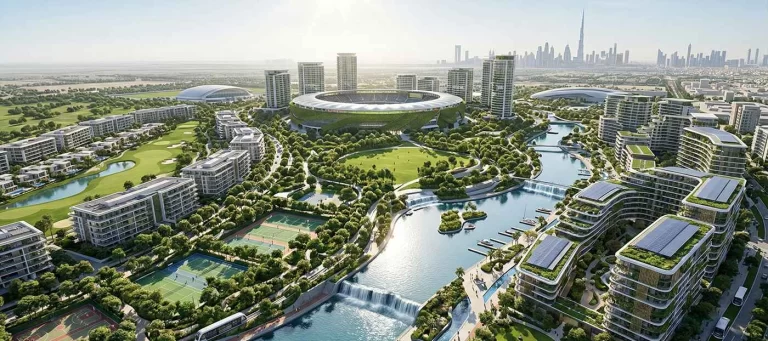
Dubai Sports City is a 50-million-square-foot community in Dubailand, built around five sports venues: the 25,000-seat Dubai International Cricket Stadium, the ICC Academy, a rugby park, a multi-sport ISD facility, and The Els Club, an 18-hole championship golf course designed by Ernie Els. Construction started in 2004 and the first residents moved in from 2008. Housing is a mix of mid-rise apartment towers built around the stadium and canal, and villas and townhouses in the golf-course community of Victory Heights on the western side. The Els Club here was named Best Golf Course in the UAE at the 2025 World Golf Awards.
Dubai Sports City splits broadly into two halves. The eastern and central side is apartment country: towers such as Elite Sports Residence (ten towers around the stadium, golf course, park and canal), Global Golf Residence, Diamond Views and the Canal Residence cluster along the Dubai Canal, plus a wave of newer off-plan towers (Mag 777, Azizi Grand, Urban Park Residences, Samana Golf Views, Fairway Residences by Prescott among them). The western half is Victory Heights, a low-rise villa and townhouse community of roughly 960 homes arranged around the Els Club fairways in sub-communities including Oliva, Calida, Estella and Esmeralda. Studios and one-bedroom apartments make up the deepest, most liquid part of the rental and resale stock; villas are concentrated in Victory Heights.
Dubai Sports City is a designated freehold area under Regulation No. 3 of 2006, Dubai Land & Property Department, so non-UAE and non-GCC nationals can buy, sell and hold full ownership title here, the same as in most of Dubailand’s established communities.
The property-investor route to the UAE Golden Visa requires a DLD property valuation of at least AED 2,000,000. Dubai Sports City’s accessible pricing means the Golden Visa route here is typically opened by a larger Victory Heights villa or townhouse, or by combining more than one apartment into a qualifying portfolio. Your Fidu agent will check eligibility against the specific property’s DLD valuation so you know exactly where it stands.
Dubai Sports City combines a large stock of completed, tenanted apartment towers dating from 2008 onward with a genuinely active pipeline of new off-plan launches, handovers spread across 2026 to 2028 — recent examples reported in the market include Mag 777 (Q4 2025), a European-developer building (Q2 2026) and Azizi Grand, Urban Park Residences, Fairway Residences by Prescott and Samana Golf Views (2026). The five venues that give the community its identity — the cricket stadium, the ICC Academy, the rugby park, the multi-sport ISD facility and The Els Club — are all built and in use, with further sites in the masterplan still to be developed.
Bayut’s Dubai Sports City area guide, built from asking-price listings over the trailing 12 months, puts average apartment sale prices at AED 723,000 (studio), AED 1,065,000 (1-bed), AED 1,565,000 (2-bed) and AED 2,285,000 (3-bed). Bayut names Dubai Sports City among the top locations for affordable apartments in its Sales Market Report commentary. These are asking prices from live listings, and your Fidu agent can pull DLD-recorded comparables and the per-square-foot figure for any specific building you are considering.
The same Bayut area guide puts average asking rents at AED 45,000 (studio), AED 66,000 (1-bed), AED 91,000 (2-bed), AED 115,000 (3-bed) and AED 250,000 (4-bed), based on listings over the trailing 12 months. Demand is driven by tenants seeking an affordable, sports-and-leisure-oriented community with easy access to the wider Dubailand corridor.
Bayut’s own ROI calculation for Dubai Sports City, based on user searches over the trailing 12 months, puts apartment yields at 5.46%–6.31% depending on size, villa yields at 3.46%–5.41%, and townhouse yields at 3.82%–5.16%. This is a listings-and-search-based estimate; your Fidu agent can model the achievable yield on a specific unit using current comparables.
Service charges vary by building and are published per property on Mollak, RERA’s official service-charge platform — your Fidu agent will confirm the exact current figure for any unit you are considering.
Dubai Sports City is served by RTA’s F38 bus route, which runs between Jumeirah Golf Estates Metro Station on the Red Line and Dubai Sports City roughly every 20 minutes between 6:00am and 12:30am, giving a direct link onto the Metro network. A wider set of local and intercity bus routes also serves the area. In practice, most residents drive: the community sits directly off Sheikh Mohammed Bin Zayed Road (E311), with Al Qudra Road and Hessa Street providing secondary access. Apartment towers generally include allocated basement or podium parking for residents; villas in Victory Heights have private driveways and garages.
Dubai Sports City has one established school physically inside the community and one large, well-regarded school immediately next door in Victory Heights:
A third school, GEMS School of Research and Innovation, opened inside Dubai Sports City in August 2025 following the English National Curriculum for ages 3–14 (FS1 to Year 9). As a new school its first DSIB inspection is still ahead of it, so it does not yet carry a KHDA rating. For younger children, families use Dwight School’s own early-years provision alongside nurseries in neighbouring Motor City and Dubai Production City.
Daily needs are covered within the community: Spinneys and Carrefour Express operate here, alongside the Sports Village Plaza and the retail promenade at Canal Residence West, which adds a pharmacy, a laundry and other convenience services. Fitness options extend well beyond a standard gym given the surrounding stadium, academy pitches and the Els Club’s practice facilities. Beyond day-to-day groceries and a pharmacy run, City Centre Me’aisem, Dubai Hills Mall and Mall of the Emirates are all within roughly 10–20 minutes by car, with larger private hospitals a similarly short drive away.
Food and drink in Dubai Sports City cluster around three anchors. The Els Club clubhouse hosts Big Easy Bar & Grill, 261 Restaurant and The Greenroom; the Sports Village area has Kickers Sports Bar and a garden dining space; and Canal Residence West’s promenade adds casual options including Wingstop, Shawarma Al Karmel, Pulcinella and Copper Kettle. It is a community of sports bars, casual grills and canal-side cafes, with Dubai Hills Mall and the wider city’s restaurant scene a short drive away.
The community’s identity is its venues: the Dubai International Cricket Stadium, which has hosted IPL, PSL and Asia Cup matches; the ICC Academy’s international-standard cricket pitches; a 5,000-seat rugby park; and The Els Club golf course, rated Best Golf Course in the UAE at the 2025 World Golf Awards. A canal runs through the community connecting several of the apartment clusters, giving Canal Residence its name and its water views.
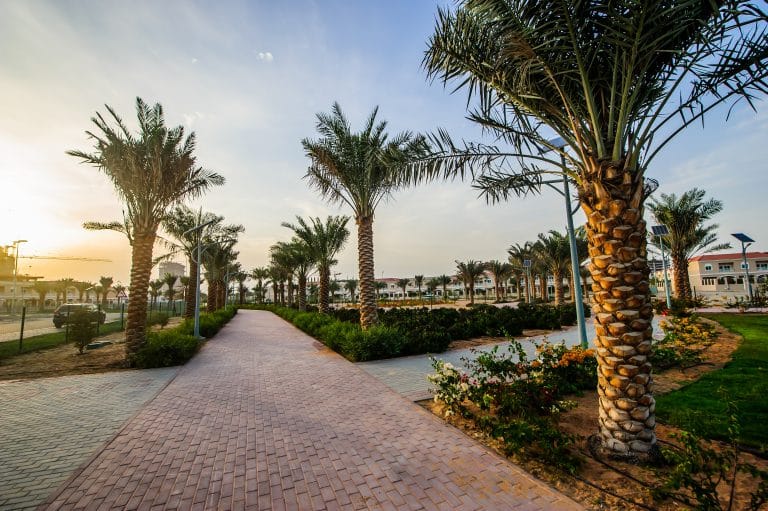
Beyond the golf course itself, landscaped parks and jogging paths thread between the apartment towers, Victory Heights has tree-lined streets and community gardens around its villas, and the various sports pitches (football, rugby, cricket nets) double as informal open space for residents even outside organised training sessions. The Els Club fairways give the community its green spine.
Dubai Sports City is a car-friendly community with a direct RTA bus link (route F38) onto the Red Line at Jumeirah Golf Estates Metro Station, and it sits straight onto Sheikh Mohammed Bin Zayed Road (E311). It is still growing: several towers are mid-build for 2026–2028 handover, and further sites in the masterplan remain to be developed, which is where the area’s future upside sits. Dining and retail here are convenience-level, with City Centre Me’aisem, Dubai Hills Mall and Mall of the Emirates all roughly 10–20 minutes away for a bigger trip. And because Dubai Sports City spans towers built by different developers over nearly two decades, there is real choice in specification and price — viewing the specific building, and checking its service-charge history, is how you find the right one, and your Fidu agent will arrange both.
The nearest genuine comparison is Motor City, Dubai Sports City’s immediate neighbour across Al Qudra Road. Both are freehold, mid-market Dubailand communities built around fast road access and a single-purpose theme (motorsport at Motor City’s Dubai Autodrome, multi-sport venues and golf here), and both mix apartment towers with lower-rise clusters. Motor City is somewhat more built-out around its retail spine, while Dubai Sports City has a larger active construction pipeline and a wider range of building ages and styles to choose from.
Jumeirah Village Circle is the other common comparison for investors screening affordable freehold apartment areas. JVC is denser and more centrally located, with a larger retail base (including Circle Mall) and a bigger apartment resale and rental market, and it shares Dubai Sports City’s mid-market positioning and road-first connectivity. Buyers choosing between the two are usually trading Dubai Sports City’s sports-and-golf lifestyle and lower density for JVC’s larger inventory and more central location.
Dubai Sports City sits on Sheikh Mohammed Bin Zayed Road (E311) in Dubailand, with Al Qudra Road and Hessa Street as secondary routes. As typical-traffic estimates: Downtown Dubai and Dubai Mall are roughly 25–30 minutes by car, Dubai Marina and JBR around 20–25 minutes, and Dubai International Airport (DXB) around 30–35 minutes; Al Maktoum International Airport (DWC) to the south is comparably close, around 25–30 minutes depending on traffic and exact origin point within the community.
Dubai Sports City is best suited to buyers targeting entry-level apartment prices in a freehold Dubailand community with a genuine, internationally recognised sports and golf identity, and to investors who value a deep, fast-moving studio-and-one-bedroom rental pool. Buyers looking to reach the AED 2,000,000 Golden Visa threshold from a single purchase here will generally be looking at a Victory Heights villa or townhouse, and your Fidu agent can show you the options. On Bayut’s listings-based ROI figures, apartments here (5.46%–6.31%) lead villas and townhouses (3.46%–5.41%) — a genuine data point drawn from listings-and-search data. Any investment decision is best underwritten against a specific building’s current asking prices and service-charge history, which your Fidu agent will pull for you.
Sales, rental and ROI figures are drawn from Bayut’s Dubai Sports City area guide — asking-price, asking-rent and search-based ROI tables built from live listings and user searches over the trailing 12 months, not confirmed DLD transactions. Service charges here are set per building and published per property on Mollak, RERA’s official platform, which is where Fidu confirms the current rate for a specific unit.
Where a figure could not be tied to one of these named, dated sources, it is described qualitatively rather than estimated.
3 properties found
AED 750,000
 Studio Bed
 1 Bath
 470 sq-ft
Fairway Residences By Prescott, Dubai Sports City, Dubai

Listing by
Ani Sarukhanyan
AED 605,000
Studio Bed
1 Bath
454 sq-ft
Giovanni Boutique Suites, Dubai Sports City, Dubai

Listing by
Salik Aziz
AED 1,170,000
1 Bed
2 Bath
722 sq-ft
Sportz By Danube Tower 2, Sportz by Danube, Dubai Sports City, Dubai
Listing by
Salik Aziz